For as long as anyone can remember, brands and businesses have always been focusing on Search Engine Optimization, or SEO. In fact, a big chunk of marketing strategy would go into planning how to make a product or content rank in search engines – and help it stay there. However, with the rise of AI, there are two more practices to incorporate into this strategy: AEO and GEO.
If you see any content that’s been recently produced – from a service page or a blog post – you’ll find it meeting the requirements of all three: SEO, AEO, and GEO. Yet, many people get confused while considering AEO vs GEO, not understanding how different they are in the way they approach the content, and how their success is shown.
So, What Exactly Is Answer Engine Optimization?
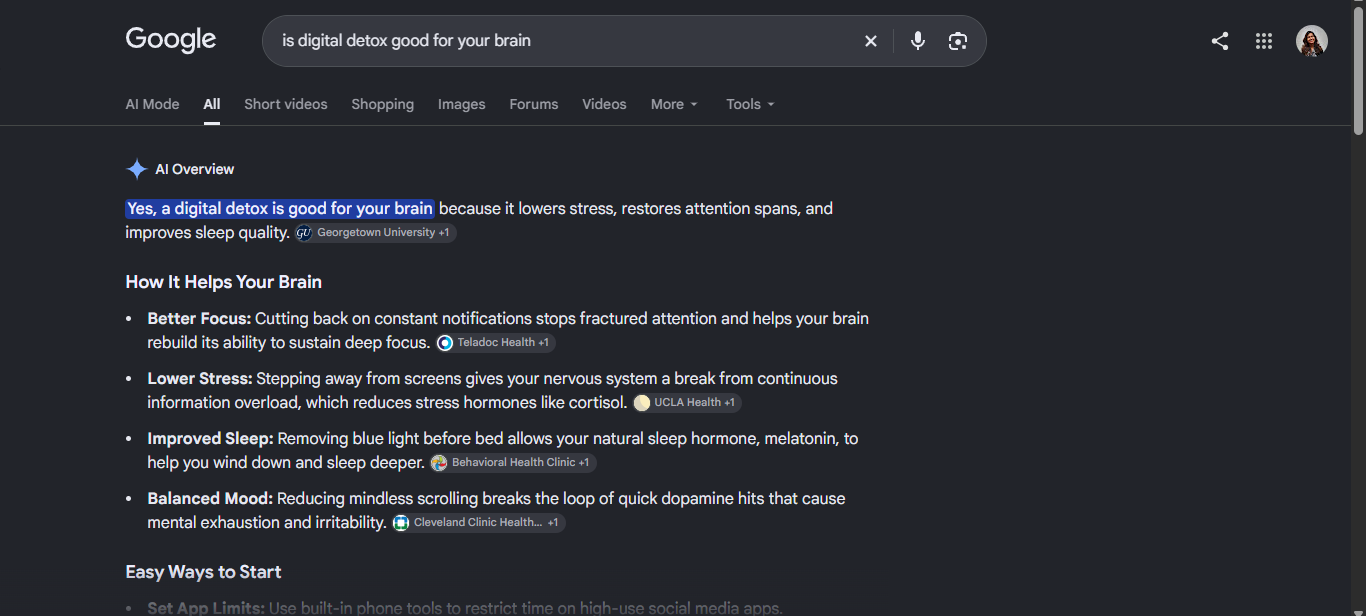
Answer Engine Optimization, or AEO, is about structuring your content in a specific way to help answer engines quickly pull out information for the queries people are searching for. A simple example is the to-the-point answers that come up at the top of search results, giving you the information without making you scroll down.
The idea behind AEO is pretty straightforward – to make your content easy to pick apart, so the answer engines can present the information quickly. So, it’s necessary to structure your content around self-contained sections, with question-based headings and direct answers. You can also use lists, tables, and FAQs (wherever appropriate, of course) to make your blog easier to understand.
And What is Generative Engine Optimization?
Generative engine optimization, or GEO, is the practice of creating and optimizing content to increase the chances of it being discovered, understood, referenced, or cited by genAI systems when they respond to people’s queries.
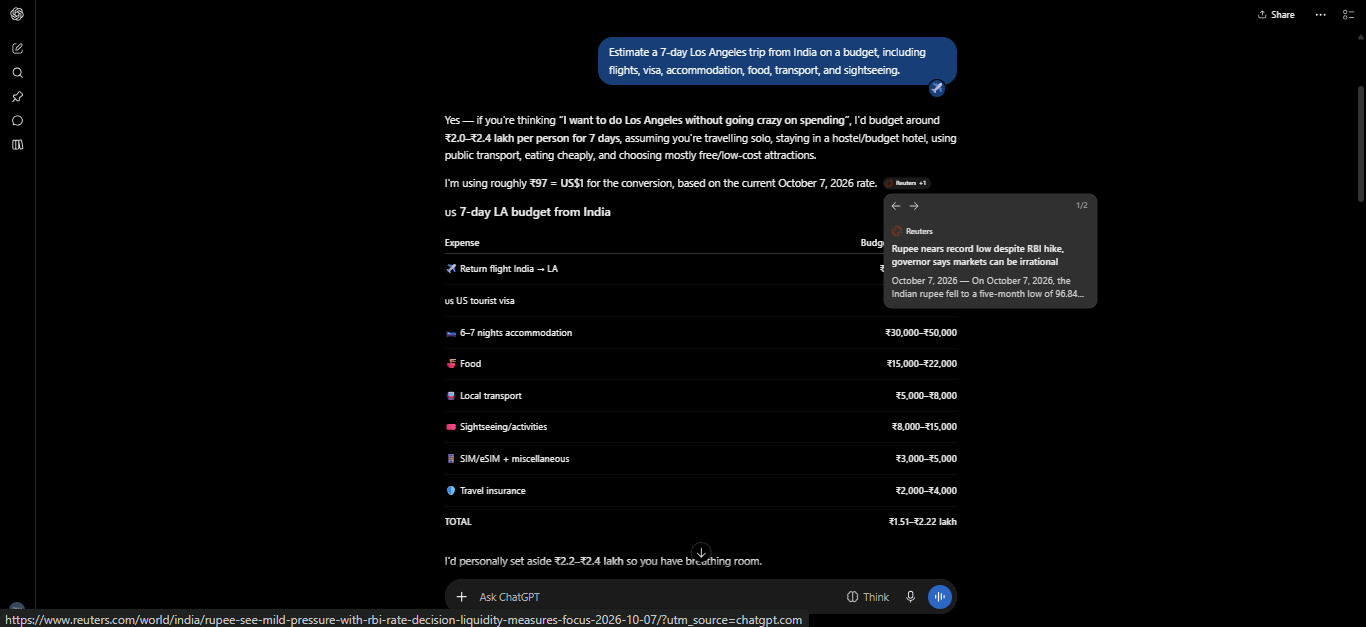
With GEO, what’s in your content matters just as much as how you present it. As an example, say you’ve written a travel guide on a destination based on your own experiences and current prices and details that someone planning a trip there would find useful. So, when someone asks a question about any of those topics, AI systems might use your guide as a source because of all the specific and credible information you’ve included in it.
AEO vs GEO: How Are They Different?
It’s easy to notice the difference between SEO and AEO or even SEO and GEO. However, when considering AEO vs GEO, the difference is much more nuanced – not just in the way they function but also in the way they help in making your content perform, as you can see in the table below:
| Aspects | AEO | GEO |
| Core Purpose | Helps answer engines find relevant information and present it in an answer to a query. | Makes your content more likely to be used or referenced in an AI-generated response. |
| Content Should Have | Concise answers, question-based headings, to-the-point explanations, lists, tables, FAQs, etc. | Original ideas, useful data, first-hand experience, credible sources, and specific examples. |
| Potential Success Metrics | Your content surfaces increasingly as a direct answer to relevant queries. | Your content gets increasingly used, referenced, mentioned, or cited in AI-generated responses. |
| The Key Question | Can an answer engine easily find and use my content in an answer? | Why would a genAI system choose my content as a reliable source? |
| Relationship with SEO | Uses SEO as a foundation, while making information easier to find, extract, and present. | Uses SEO as a foundation, while making content more useful, credible, and valuable as a potential source for AI systems. |
| Simplest Way to Remember | AEO makes your content easy to answer with. | GEO makes your content worth using in AI responses. |
AEO Vs GEO in Action: A Practical Example
AEO and GEO can seem so similar that distinguishing between the two can be confusing. So, let’s look at an example to see how each strategy works together.
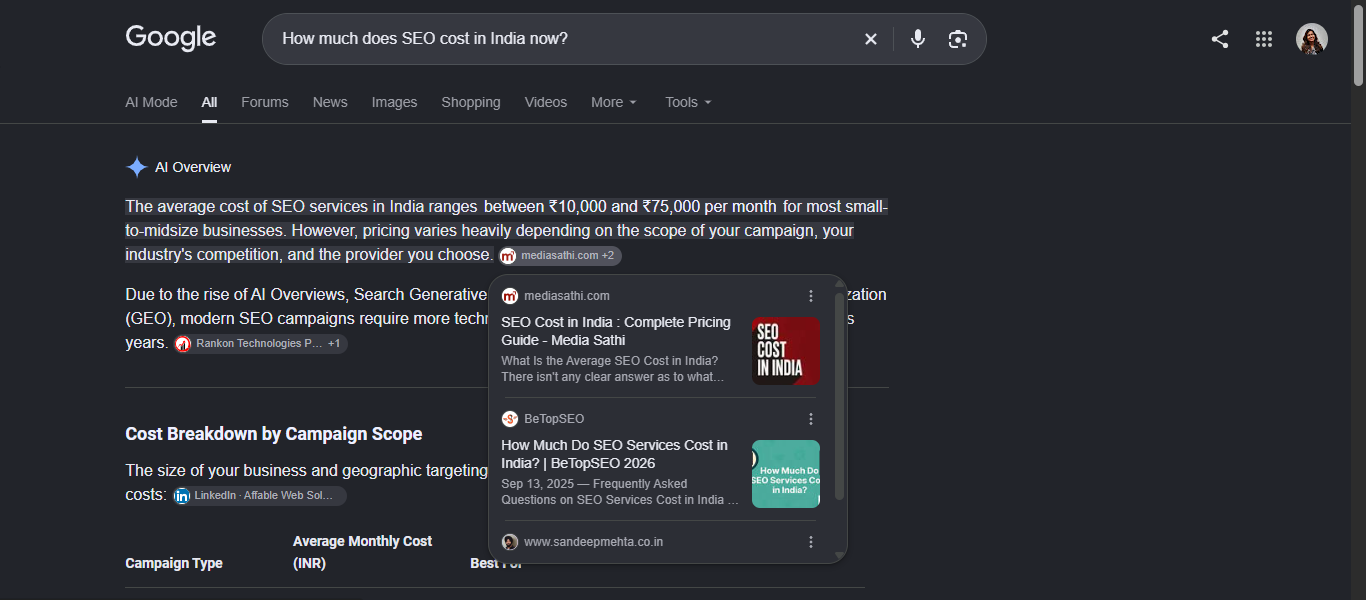
Imagine a digital marketing agency publishes a detailed article on ‘How Much Does SEO Cost in India? – A Complete Pricing Guide for 2027’. It covers SEO pricing ranges, factors influencing the total expenses, costs for different types and sizes of businesses, along with the agency’s own research and case studies.
Let’s say you search for How much does SEO cost in India now? And the article happens to cover the exact question. Then the answer engines can pull the relevant information from that article and present it in a short answer in the results, along with a link to the source. You get the basic information without opening anything – that’s Answer Engine Optimization in action.
Now, let’s say you ask ChatGPT – or Perplexity or Claude – How should I budget for SEO, and what factors should I consider in choosing an SEO agency? Here, the AI system sifts through multiple sources to gather relevant information and generate a more detailed response. It may even potentially use the agency’s article as one of those sources. And that’s what GEO does.
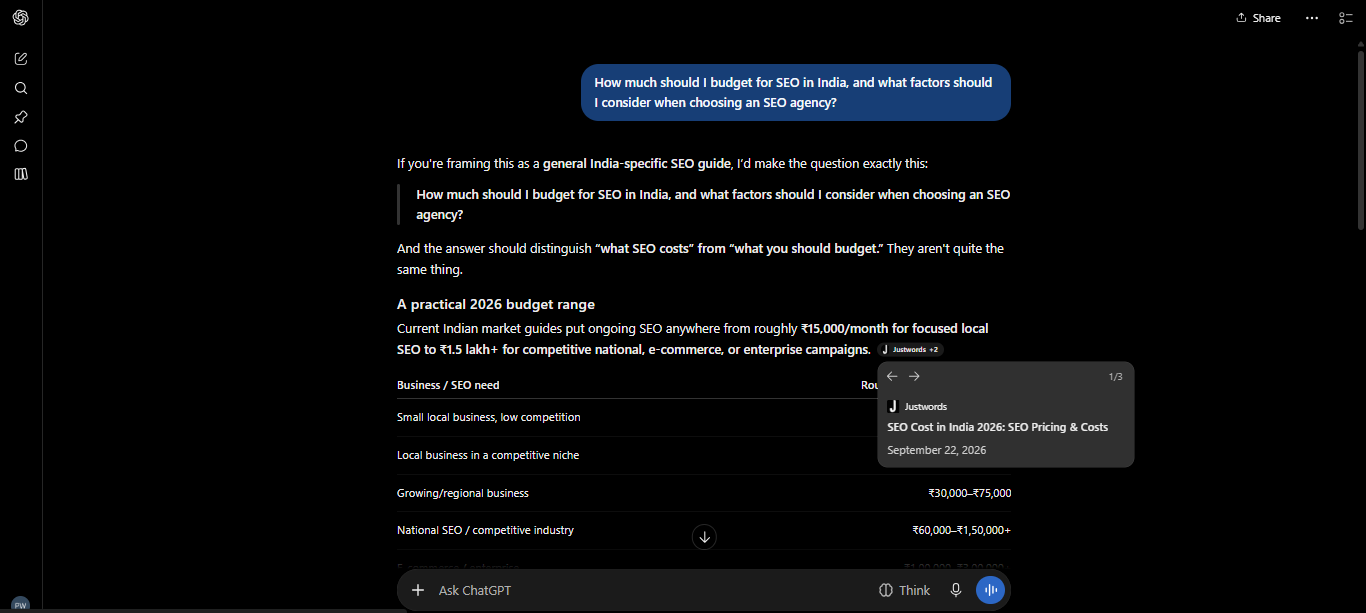
AEO focuses on making the content easy to identify, extract, and present as a direct answer. GEO, on the other hand, emphasizes the originality and credibility of the information, as that’s what will make genAI systems refer to it. In simpler words, both AEO and GEO work with the same content – but approach it differently.
What Does the E-E-A-T Framework Mean for AEO and GEO?
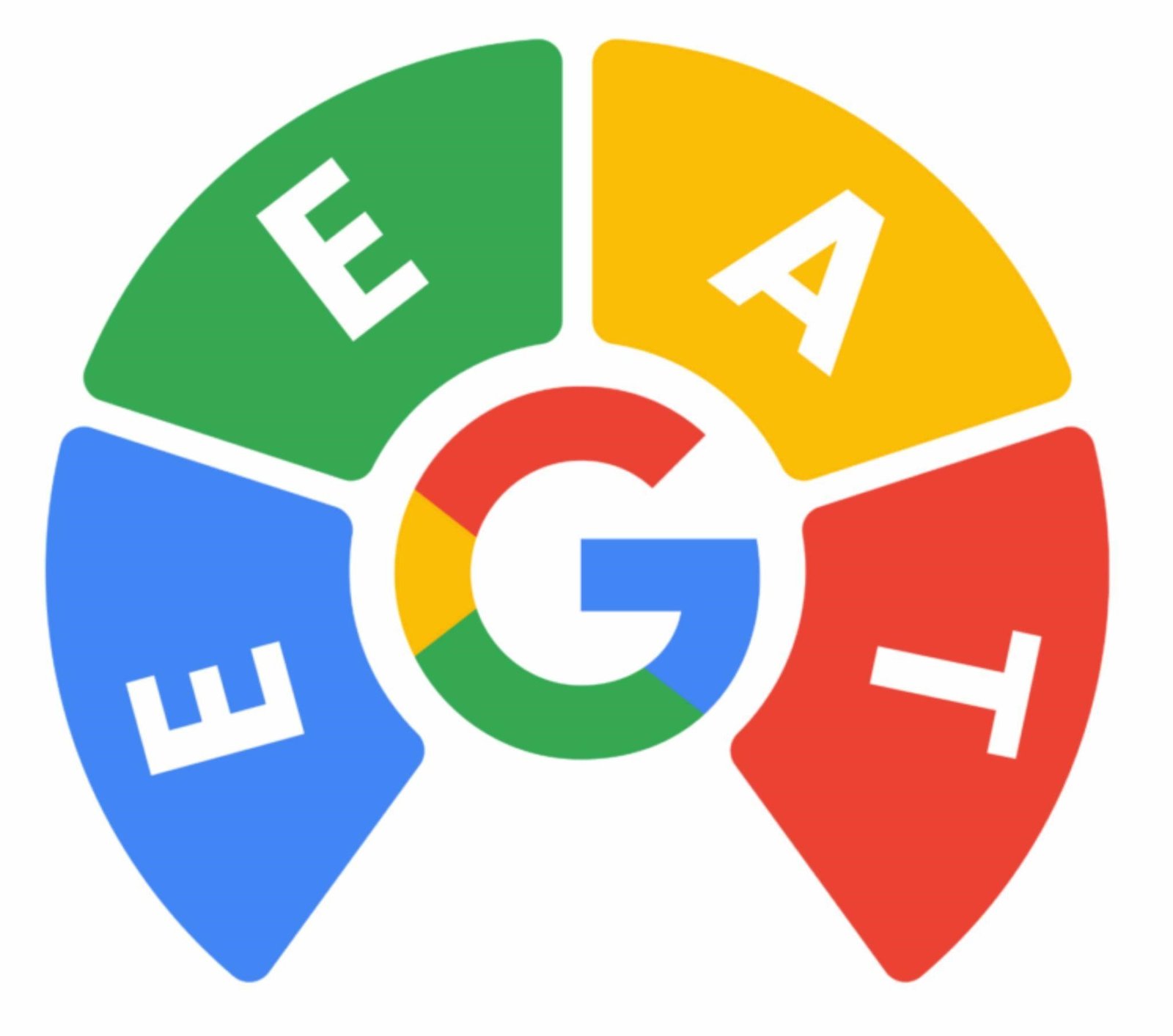
E-E-A-T is a specific framework Google uses to help its Search Quality Raters determine whether the content is quality and reliable enough to appear in the search results. It stands for Experience, Expertise, Authoritativeness, and Trustworthiness – which helps in showing whether a piece of content shows first-hand experience, expert knowledge, and credibility.
Creating content that meets these four qualities can make it more useful and trustworthy for SEO. And, by extension, even Answer Engine Optimization and Generative Engine Optimization can benefit from E-E-A-T immensely. How? Well, for AEO, well-structured and trustworthy content gives AI engines more reliable information to present in response to queries. With GEO, this framework can make the article a stronger potential source for genAI systems to use or reference.
The bottom line is: E-E-A-T essentially helps strengthen the content that SEO, AEO, and GEO are trying to rank, mention, and reference, respectively.
How to Optimize Existing Content for AEO and GEO?
Here’s the good news – you don’t have to create content that’s AEO- and GEO-friendly from scratch. That’s because your existing stuff may already contain useful information, and a few tweaks here and some structural changes there will make it good to go. Don’t know how or where to start? Here are the questions to ask to help you decide if the content is worth optimizing:
Does it answer the questions people are asking?
Some of your content may already have useful answers – but hidden under long and vague explanations. To make that happen, you can rewrite the main answer, remove redundant information, and use questions as headings (wherever they can naturally fit, of course).
Does the content offer something worth referencing?
Next, look at what makes your content worth coming back to. Does it have original research and useful data, or describe case studies or personal experiences? If yes, then you can straighten out the blog’s flow. However, if it only repeats what’s already out there, you can revisit it to add something more valuable.
Is the information still relevant and up to date?
An article that was relevant and useful years ago might not hold up today. So, it’s time to refresh your content – update outdated examples, references, and even statistics, tighten up the sections, and remove anything that doesn’t serve a purpose anymore.
Can AI systems easily understand the content?
Different AI systems can interpret and extract information in different ways. So, take a couple of minutes to look over the rewritten content as a whole. Apply all the structural points we’ve discussed so far to make the information flow easily and naturally – not just for the readers but also for the AI systems.
Final Words
On top of incorporating SEO fundamentals, content these days also needs to be AEO- and GEO-friendly. That’s because AEO helps your content win visibility for your brand or business, while GEO focuses on making the same content valuable for AI to mention. So, while there’s a clear reason to consider AEO vs GEO, both are becoming increasingly important to keep up with the ever-evolving search landscape.