At a cursory glance, the sources that AI systems use in their responses might seem completely random. One answer might cite Wikipedia – but it makes sense, given that platform’s reputation as a go-to source for basic information on almost everything. However, another response (for the same query) might rely on Reddit threads, using people’s personal opinions and experiences to put together a straightforward answer.
Well, there’s a very structured system underneath this seemingly random process. AI search engines consider several factors while deciding which brands and sources to include in their answers. Before exploring how to get your content featured in AI responses, it’s necessary to understand how these citations actually work.
First, What is an AI Citation?
An AI citation is when an AI tool links to a website or references a source to show where its answer is coming from. While a traditional search shows a list of webpages, AI search engines get their information from those pages and organize everything in a single response, sometimes with citations linking back to those sources.
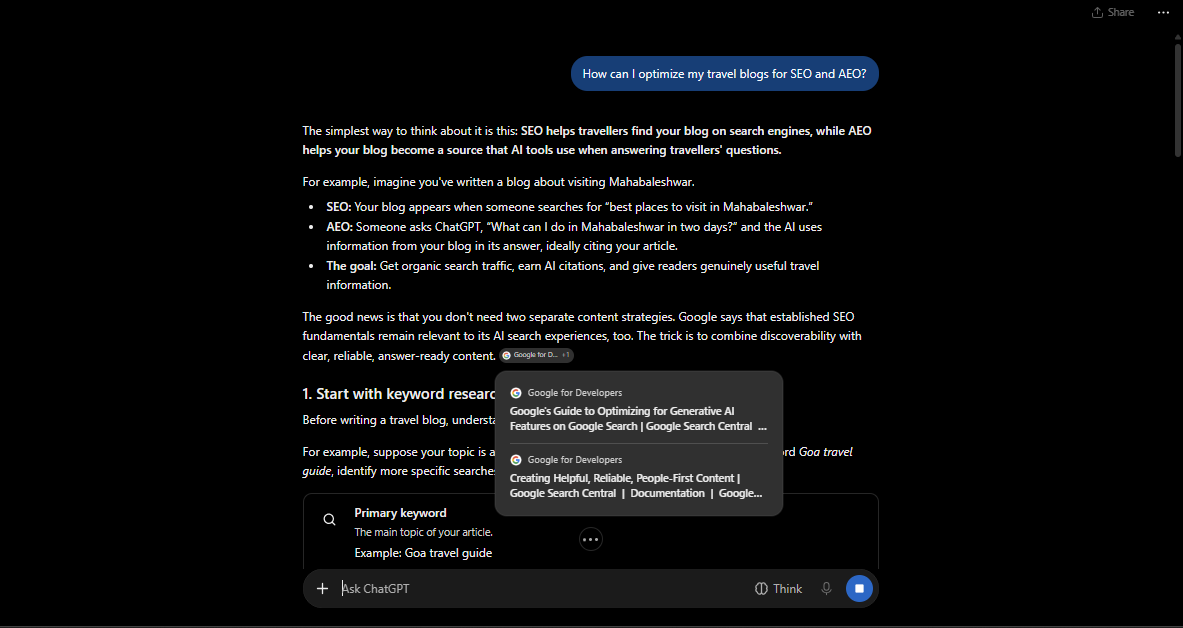
So, let’s say you ask ChatGPT How Can I Optimize my Travel Blogs for SEO and AEO?, it might draw content from Google’s SEO documentation and relevant travel websites. The clickable links included throughout the answer – or at the bottom – are the AI citations that you can click on to explore the source in depth.
So, What Happens When You Search with AI?
AI search is a recently developed technology that uses artificial intelligence to provide answers to your queries. When you start a search on an AI-powered search engine, the system first processes your query to understand the intent and context. Depending on the platform you’re using, it might answer using what its Large Language Models (LLMs) have learned during training, look up information on the web, or combine both to generate a synthesized answer.
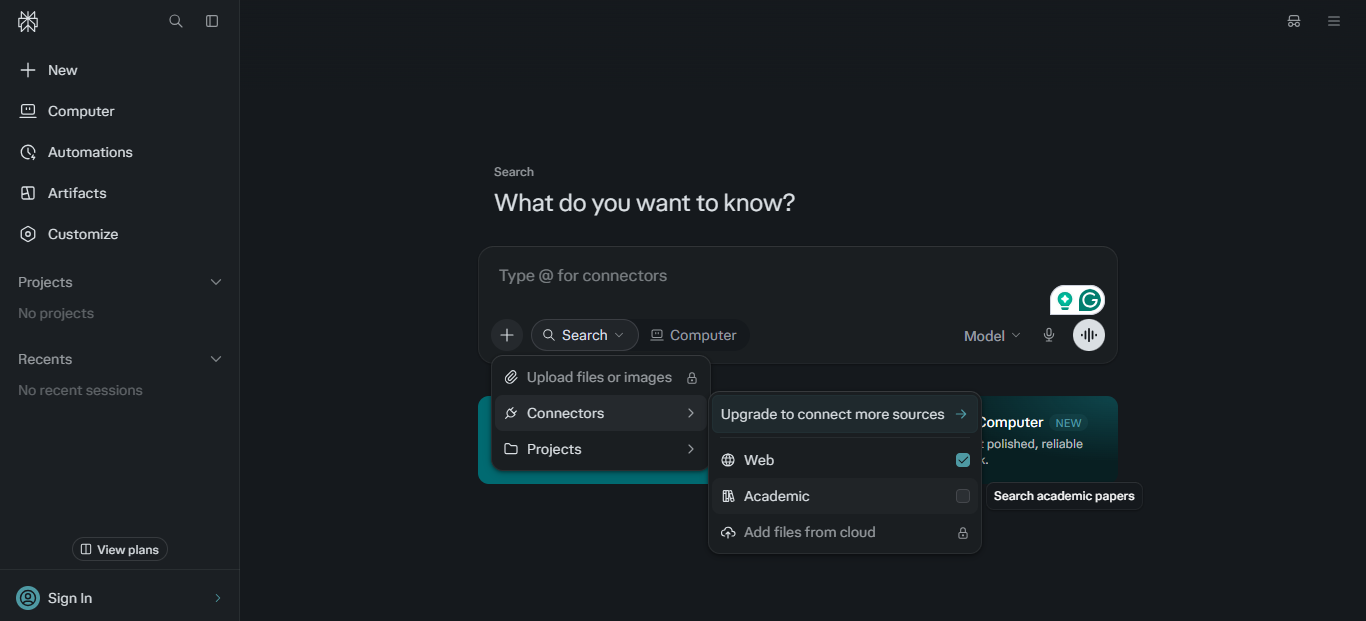
It’s important to remember that this search-and-generate process varies across most AI platforms. For instance, not every AI response may utilize a live web search. ChatGPT can search the web automatically (when needed) and also offers to let users initiate search manually. Meanwhile, Perplexity offers different search modes, including Web, Academic, and Personal Files, to help people find different types of information.
But if this process varies so much, how does an AI system decide which sources to include in its final answer?
How Does AI Pick Sources to Cite for its Answers?
AI search engines don’t cite or mention every single source they come across or look into. Instead, they look for information that fits the query and then select sources that can help answer it the best. A few things can influence which sources are ultimately chosen:
- How original and credible is the content?
- How directly does it answer the user’s query?
- How up to date the information is, particularly for a topical question?
- How technically accessible the webpage is?
However, meeting these criteria doesn’t really guarantee that you will get an AI citation. The most these questions can do is improve your chances of getting noticed. Why? That’s because the retrieval and citation patterns work differently across the platforms. Different AI tools may cite different sources when answering the same question – and even the same can happen with the same AI search engine.
According to a research synthesis by Machine Relations, YouTube appears more frequently in Google’s AI answers, ChatGPT refers to Wikipedia, while Perplexity prefers Reddit threads. This is precisely why brands and businesses need to have a comprehensive strategy to meet the citation criteria for all the major AI engines.
So, when there’s no guaranteed formula, how can one go about improving their brand’s chances of getting cited?
How to Write Content That Is More Likely to Be Cited by AI?
Here’s the good news: getting your content cited by AI isn’t as impossible as it might seem. The idea here is to write content that’s useful to readers as well as worth referencing, rather than simply repeating what’s already out there. So, here are a few practical ways you can write and edit your content so there’s a better shot at getting cited by AI:
Make Your Search Intent Clear:
AI systems are able to interpret the meaning and context of your query, so your content doesn’t really need specific keywords to convey its intent. Instead, you should focus on answering the user’s question in clear words and covering the topic in a useful way. That doesn’t mean you must fully avoid keywords – just include them or related terms naturally to really drive the context home.
Always Write Direct Answers:
Let’s say you’re writing a blog on What Is GEO? Earlier, you might have started with an example or with a statistic, and then launch into the definition. But that kind of stalling doesn’t work for AI visibility – getting to the point within the first couple of sentences is the right move here. This way, both AI systems and readers can quickly find the answer they’re looking for, without having to dig through long paragraphs.
Prioritize Original, Accurate, and Up-to-Date Content:
Storytelling definitely makes content more engaging, but going through it may frustrate the readers looking for a particular answer – and quickly. AI works in a similar way – so, get to the point early and add verifiable claims or firsthand experiences instead of repeating what’s already available online. Maintain consistency – for tone as well as terms and phrases used – across your website and keep updating facts and references regularly to reflect Google’s E-E-A-T framework.
Link Credible Sources Where Necessary:
Google, Bing, and other search engines can pull information from various websites when generating AI answers. So, linking primary sources – like official documents and industry reports – can help support your claim. However, don’t add links just for the sake of it – explain how each source supports the point you’re making. Also, use accessible webpages instead of PDFs and include an author bio – to make content easier for AI systems to process and highlight your expertise, respectively.
Structure Your Content for Readability:
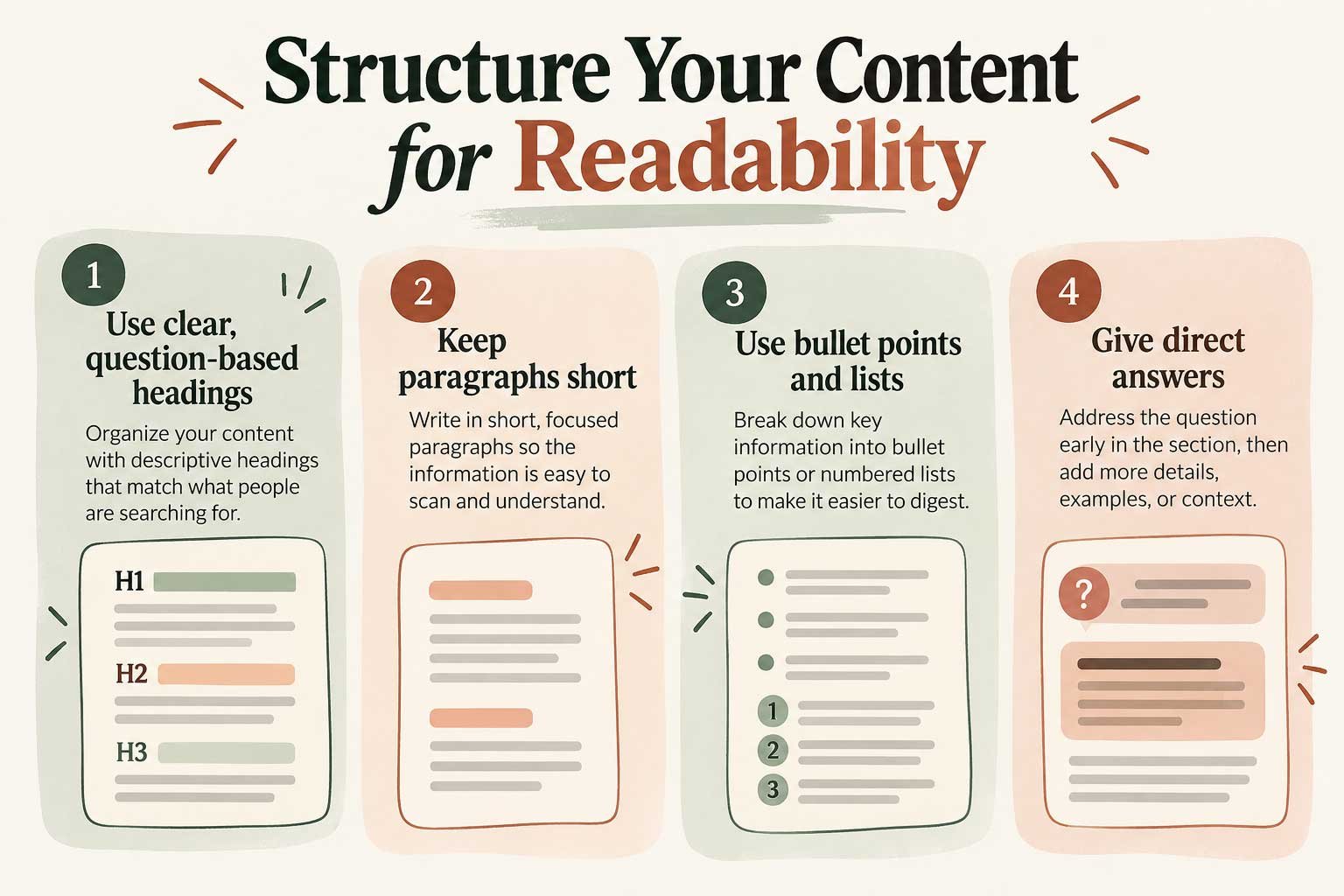
Here, you can’t just publish long walls of text and expect it to perform well simply because it’s well-written – that’s because formatting matters a lot for AI citations. So, break those walls into clear sections with question-based headings, short paragraphs, and bullet points. Doing so makes it easy for AI systems to determine just how well your content relates to a user’s query.
There are a variety of other factors that can improve your brand’s chances of getting more AI visibility, including website crawlability, schema markup, indexing, and files like llms.txt. However, these fall under the technical side of optimization – not something a writer needs to handle personally. So, if you’re focusing on just the writing side of things, the tips above are the ones that’ll help you get there.
So, What is AI Visibility and How Can You Measure It?
AI visibility is a technique of monitoring how often your brand’s content, products, or services appear in AI-generated answers. This may include brand mentions, content citations, and product recommendations – the whole shebang! While SEO visibility focuses on search rankings, AI visibility helps you understand in what way and how often your brand appears in AI answers.
Now, why does tracking this matter? Well, people are increasingly turning to AI tools to find the information they need. For instance, ChatGPT boasts over 900 million weekly active users, while Google AI mode has more than 1 billion monthly active users. So, knowing whether your brand appears in these responses can help you understand if you’re reaching your target audience through AI.
Since AI visibility doesn’t follow traditional ranking positions, SEO performance metrics alone aren’t enough. One approach you can use is the IAB’s ‘4 Ps of AI Visibility’ framework to check your visibility:
| The Ps | What It Means |
| Presence | Whether AI mentions your brand or cites your content. |
| Prominence | How prominently your brand appears in AI-generated answers. |
| Portrayal | How AI describes your brand, products, or services – and whether that information is accurate. |
| Persuasion | How effectively your AI mentions and citations drive site traffic. |
But how do you turn these metrics into actual numbers? Well, you can either track them manually or use easily available tools to make the process easier:
Manual Tracking:
The simplest way to start tracking AI visibility is to ask relevant questions across major AI platforms. Start by creating a prompt library that targets what your audience may ask AI engines – especially those with high purchase or research intent. Then, maintain a spreadsheet with details of all your mentions, how you’re presented, and the frequency of your appearance, so you can tweak your content strategy accordingly.
Automated Tracking:
If you want to save even more time, there are loads of AI visibility tools – like Semrush’s AI Visibility Toolkit, Ahrefs, AirOps, and Frase.io – that can automate this entire process for you. Their ways of tracking brand mentions, citations, and competitor visibility do vary, so choose one that fits your needs and budget.
Final Words
AI is here to stay – and thus, it’s essential to understand the process of getting cited in an AI answer. Additionally, even if there’s no guaranteed formula for earning (and maintaining) AI citations, creating useful, credible, and well-structured content is a great place to start. Combine that with regular AI visibility tracking and your chances of getting mentioned and cited in AI answers increase even more.