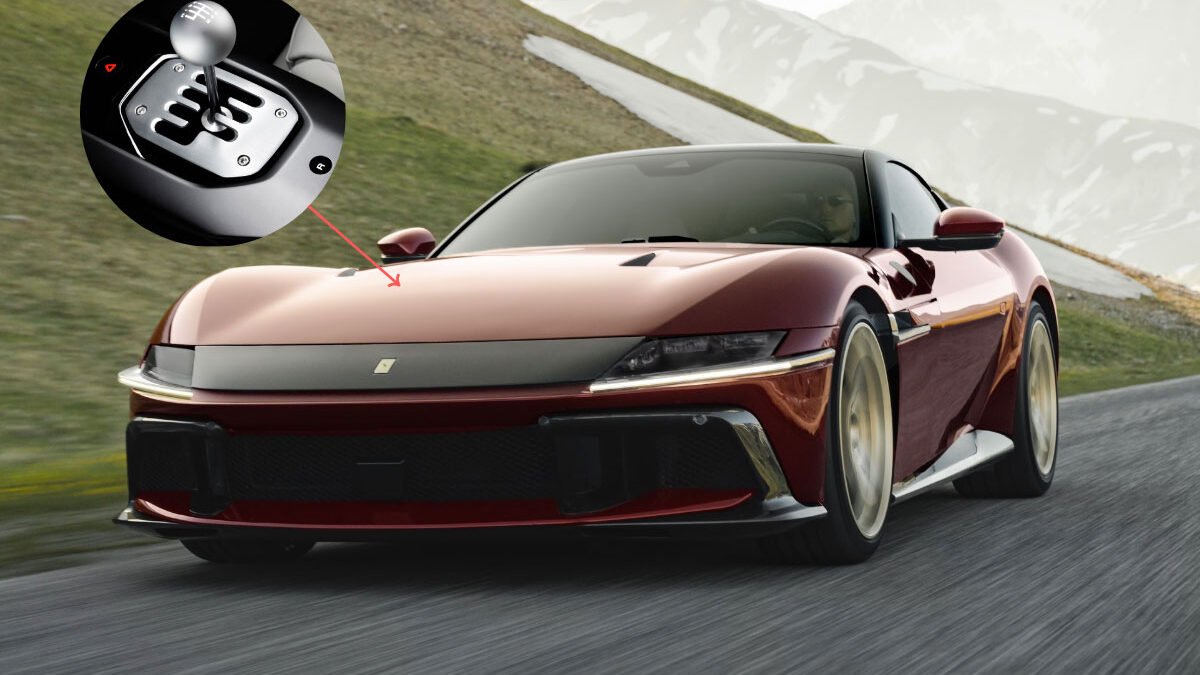
The controversial return of the manual transmission to Ferrari’s lineup isn’t quite what purists expected. The new Ferrari 12Cilindri Manuale brings back the beloved gated shifter and clutch pedal to a screaming V12, but it does so entirely through software and wires.
Instead of a traditional mechanical linkage, the Ferrari 12Cilindri Manuale features a “manual-by-wire” system. Here is a breakdown of how Ferrari engineered this simulated stick shift, why they did it, and whether it actually ruins the driving experience.
How a “Fake” Manual Works
The 12Cilindri Manuale is built on the same foundation as the standard car, utilising an 8-speed Dual-Clutch Transmission (DCT). The difference lies in the cabin interface.
- Clutch-by-Wire: The third pedal isn’t connected to a hydraulic fluid line pushing a physical clutch plate. Instead, a position sensor digitally converts your pedal pressure and sends it to the gearbox control unit. As you depress the pedal, the DCT’s automated clutches open; as you release it, they engage.
- Shift-by-Wire: The gated gear selector is essentially a high-end sim-racing rig. Hall effect sensors read the lever’s position, and a push-pull solenoid provides physical force feedback to mimic the sensation of sliding into gear.
- The Rules of Engagement: In manual mode, you are restricted to gears one through six (plus reverse). Just like a real manual, if you let the clutch out too fast without giving it enough throttle, you will stall the car. You are also entirely responsible for heel-toe rev-matching.
If you get tired of shifting, you can push a button to switch back into fully automatic mode, allowing the car’s computer to seamlessly manage all eight gears.
Why Fake It?
According to Ferrari, the primary reason for a by-wire manual is that modern traditional manual transmissions cannot handle the torque output of their 6.5L V12. However, the aftermarket Tremec transmissions can comfortably handle over 1084 NM of torque (well beyond the 12Cilindri’s 678 NM).
The more likely reality comes down to homologation and economics. Developing a bespoke mechanical manual transmission for a limited run of just 1,499 cars would be astronomically expensive. By utilising the pre-certified 8-speed DCT and writing new software to simulate a manual, Ferrari avoids the regulatory headache of crash-testing and certifying an entirely new drivetrain.
The Pros and Cons of a Software Manual
While purists may scoff at the lack of mechanical authenticity, a by-wire manual presents some unique engineering advantages.
The Advantages:
- Idiot-Proof Reliability: Because the computer is ultimately shifting the DCT, you cannot mechanically “money shift” the car (e.g., accidentally shifting into 1st gear while doing 100 mph, destroying the engine). The system will simply lock you out. It also prevents wear on synchros from sloppy shifts.
- Aggressive Gearing: Traditional modern manuals have incredibly tall gears to meet fuel economy standards. Because this uses the short, tightly packed first six gears of an 8-speed automatic, you get to hear the V12 scream to its 9,500 RPM redline much more frequently.
- Two Cars in One: You get the engagement of a manual when you want it, and a world-class automatic for traffic.
The Disadvantages:
- Authenticity: At a price tag approaching $680,000 (roughly $200,000 more than the standard model), buyers might feel cheated knowing the mechanical sensation is essentially force-feedback generated by a solenoid.
- Software Reliance: Software-defined driving means potential for latency, stripping away the raw, analogue connection that enthusiast drivers crave.
A Victory for Joy Over Speed
Modern supercars are plagued by a spec-sheet war, chasing meaningless lap times and unachievable top speeds.
The most remarkable thing about the 12Cilindri Manuale isn’t the technology; it’s that Ferrari intentionally made the car slower to make it more fun. Shifting yourself will always yield slower 0-60 times than letting a DCT do the work, and restricting the manual mode to six gears technically lowers the car’s top speed. Ferrari traded raw performance numbers for driver engagement, proving that the ultimate luxury isn’t going faster, but feeling more connected while doing it.