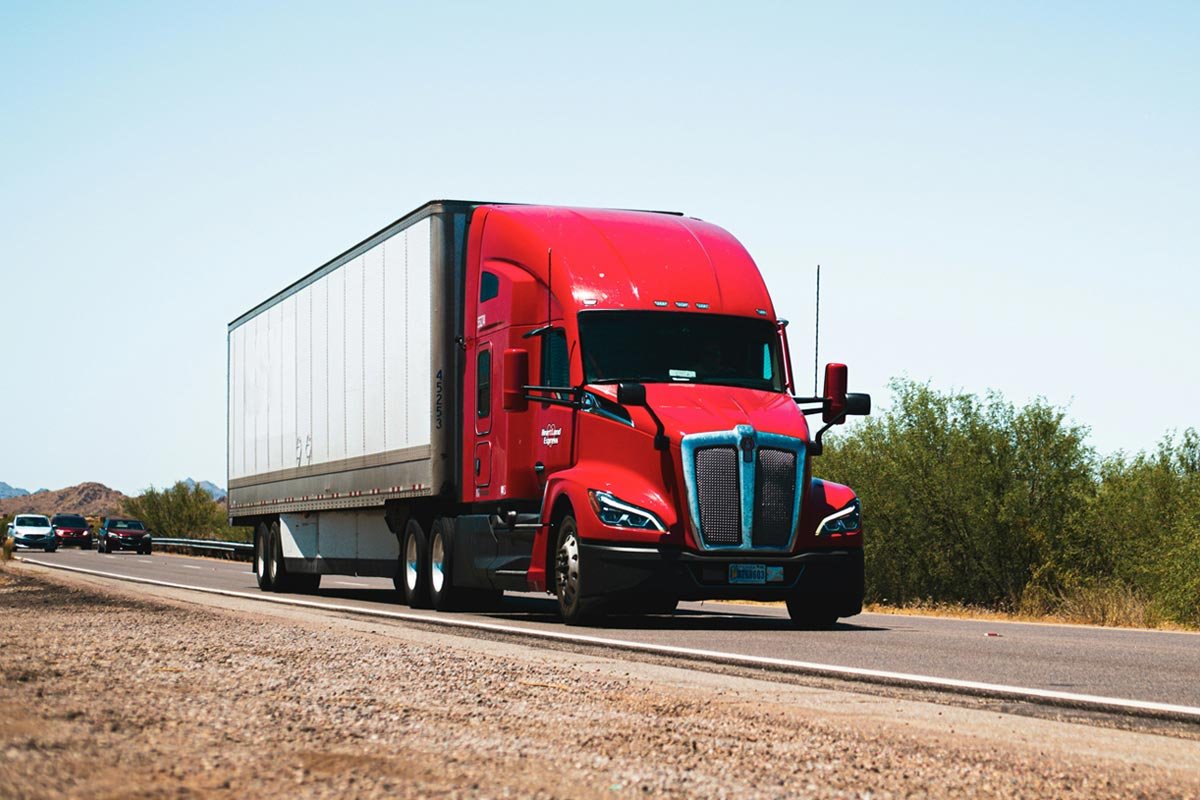
Every modern semi truck spends most of its fuel pushing air out of the way. At highway speed, aerodynamic drag is the largest force a tractor-trailer works against, bigger than rolling resistance and bigger than the grade on most routes. That’s why a Cascadia, a T680 or a VNL looks the way it does, with a sloped hood, a roof fairing sized to the trailer, chassis skirts down the sides and mirrors shaped to keep air attached rather than tumbling off the corners.
Knowing where that drag comes from explains why some parts of the truck are worth money and others aren’t. It also explains the compromises owners accept when adding exterior parts, why trailer upgrades often pay back faster than tractor ones, and why two nearly identical trucks on the same lane finish a month a mile per gallon apart.
Where the Drag Comes From
Air resistance climbs with the square of speed, so a truck at 70 mph fights roughly a third more drag than the same truck at 60. On a loaded combination running interstate miles, well over half the engine’s output goes to overcoming air rather than moving weight. That resistance doesn’t spread evenly, though, and it collects in a few areas that behave differently.
The Front End and the Gap
The bumper, hood and windshield take the first hit, and builders have spent decades rounding those edges and pulling mirrors toward the body. Behind the cab sits the tractor-trailer gap, where air spills into the space between the sleeper and the trailer nose and turns into turbulence that follows the truck down the road. Cab extenders narrow that opening, and a shorter wheelbase does the same job, although it costs maneuverability and fuel capacity.
The Underbody and the Wake
Underneath the trailer, air runs into the landing gear, bogie and axles and tumbles through the space. Chassis fairings and side skirts shield that area and account for much of the savings available on any combination. At the back, the flat rear of a dry van drags a low-pressure wake that pulls against forward motion, which is what boat tails exist to reduce. Both areas belong to the trailer rather than the tractor, and that matters for anyone hauling equipment they don’t own.
The Tractor’s Own Shape
Cab design has converged for good reason. Two decades of wind tunnel and computational work pushed every manufacturer toward the same broad answer, which is a sloped hood, a full roof fairing matched to trailer height, closed chassis fairings and aero mirrors or cameras. Fairing height matters more than people expect, because a fairing set for a 13’6″ van does nothing behind a flatbed and costs fuel behind a shorter trailer. Resetting it when the usual trailer type changes is one of the few free improvements on the truck.
Bolt-On Exterior Parts and the Tradeoff Owners Accept
Exterior additions are where personal preference meets the drag budget, and most owners know what they’re trading. Bolting a freightliner cascadia visor onto a high-roof cab cuts glare through the top of the windshield and gives the truck a finished look, and it also puts a flat surface into airflow the factory shaped to stay attached. The penalty isn’t dramatic, but it scales with drop depth, so an 18-inch visor asks less of the fuel budget than a 22-inch one on the same cab. Drivers running east-west into low sun generally decide the glare control earns its fraction of a percent.
Other bolt-ons work the same way. Bug deflectors, stacked lights, breather covers and deep drop visors each carry a small cost, and hanging several on one truck adds them together. Knowing which ones you’re paying for is the difference between a considered build and a truck that quietly lost half a mile per gallon over three seasons.
The Trailer Is Half the Problem
Fleets spent years improving tractors while pulling the same boxy vans behind them, and the trailer holds most of the remaining easy gains. Skirts, gap devices and rear fairings together can be worth one to ten percent in fuel economy depending on the combination and duty cycle, with skirts alone usually landing in the low single digits. The complication is that trailers get dropped, swapped and shared, so a carefully spec’d tractor may spend the week behind a bare van. Owner-operators pulling dedicated equipment can at least match tractor to trailer and measure whether the match did anything.
Speed, Wind and the Driver
Equipment sets the ceiling and driving decides how close the truck gets to it. Trimming cruise speed by five miles an hour does more than most add-on devices manage, and one owner-operator running a downsped next-generation tractor with matched aero equipment has pushed a working truck past eleven mpg by attending to both. Crosswinds change the arithmetic too, because yaw raises drag sharply and side skirts earn far more across open plains on a windy day than on a still one.
Keeping the Package Working
Aerodynamic parts only help while they’re intact and sitting where they belong, and a damaged one can cost more than a missing one.
Fairing gaps: check that cab extenders still close the gap after a hard turn or a dock strike, since a bent extender can leave a messier opening than none at all.
Skirt damage: replace torn or partially detached panels rather than running them, because a flapping skirt adds turbulence and catches curbs and snow banks.
Roof fairing height: reset it whenever the usual trailer height changes, and confirm the setting after any shop visit that involved pulling roof panels.
Loose hardware: walk the truck looking for missing fasteners on fairings and deflectors, the cheapest inspection here and the one most often skipped.
Aerodynamics rewards a lot of small things rather than one large purchase, and the truck at the top of the year’s fuel report is usually the one where nothing was left broken or mismatched. If you’re deciding where to put money first, look at the trailer and at your cruise speed before you touch the tractor, and treat any exterior part you add as a cost you chose rather than a surprise you find at the pump.