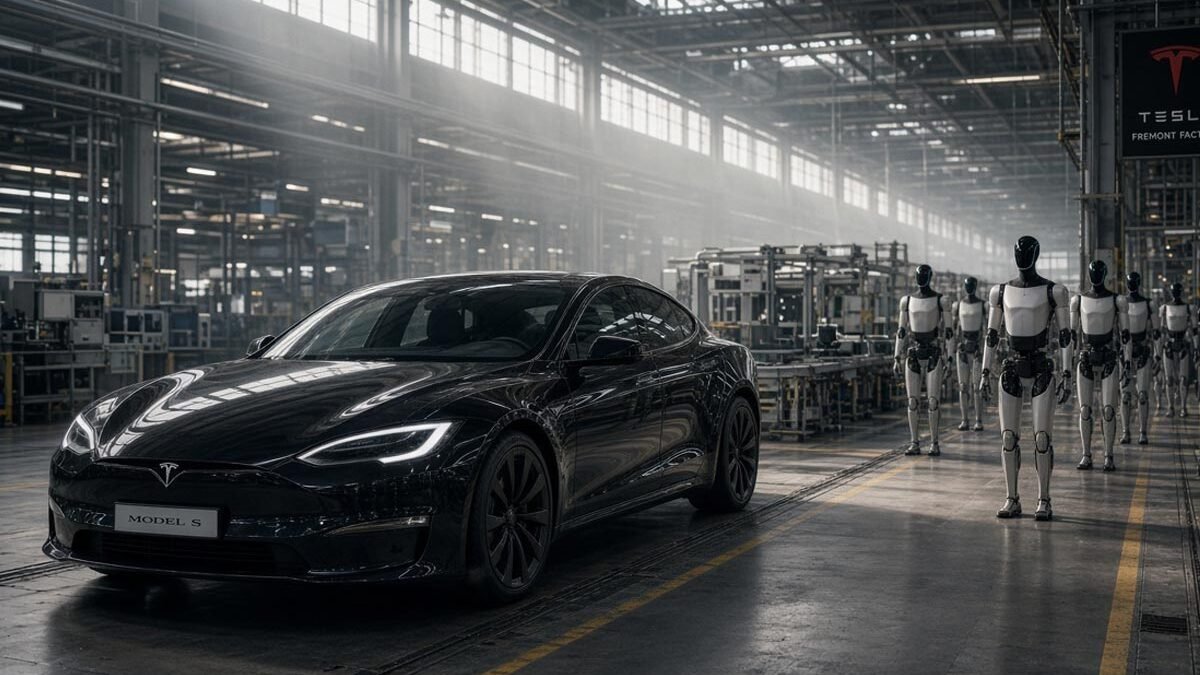
In May 2026, the last Tesla Model S rolled off the production line at the company’s Fremont, California factory. After 14 years and roughly three-quarters of a million vehicles delivered worldwide, Tesla’s original flagship sedan and its sibling, the Tesla Model X, received what CEO Elon Musk called an “honourable discharge.”
The decision, first announced on Tesla’s earnings call in late January 2026, marked the end of an era. The Model S had done more than almost any other car to prove that electric vehicles could be desirable, fast, and practical. Its retirement was not driven by technical failure or a sudden collapse in demand, but by a deliberate strategic choice: Tesla is reallocating factory space and company focus toward autonomy, artificial intelligence, and humanoid robots.
A Brief History of an Influential Car
Launched in 2012, the Model S was Tesla’s first mass-produced vehicle. It offered long range, rapid acceleration, and a high-tech cabin at a time when most electric cars were short-range compliance vehicles. Over the years, it received continuous updates rather than traditional generational redesigns, new motors, bigger batteries, Autopilot and Full Self-Driving hardware, the tri-motor Plaid powertrain, and multiple interior and exterior refreshes. By the final 2026 model year, it could claim more than 400 miles of EPA-estimated range in its longest-range configuration and 0–60 mph times under two seconds in Plaid form.
Yet by the mid-2020s the Tesla Model S and Model X had become niche products. The vast majority of Tesla’s volume and profit came from the higher-volume Model 3 and Model Y. Deliveries of “other models” (the category that included the S, X, and Cybertruck) represented only a small fraction of total output and had declined sharply in the preceding years. The Fremont lines dedicated to the S and X were running well below their theoretical capacity.
The Official Reason: Room for Robots
Musk was characteristically direct. Production of the Model S and Model X would end in the second quarter of 2026 so that the space in Fremont could be converted for manufacturing Optimus, Tesla’s humanoid robot. “It’s time to basically bring the Model S and X programs to an end with an honourable discharge, because we’re really moving into a future that is based on autonomy,” he said on the January call. He added that anyone still interested in buying one should order quickly.
The company followed through. Custom orders closed in early April 2026. By mid-May, the final cars had been built. Tesla later confirmed that the production lines were dismantled and the area prepared for robot assembly. Existing owners were assured of continued support, Supercharger access, and over-the-air software updates.
Strategic Context
The move fits a broader pattern. Tesla has spent years positioning itself less as a conventional car company and more as an AI and robotics firm that also makes vehicles. High-volume, software-defined platforms such as the Model 3/Y architecture and the forthcoming robotaxi efforts align better with that vision than low-volume, ageing luxury vehicles that require dedicated manufacturing capacity.
Sales data reinforced the economic logic. Even with a final surge of buyers seeking one of the last examples, the Model S and Model X never regained the centrality they held in Tesla’s early years. Keeping the lines open for sentimental or brand reasons had become harder to justify when the same square footage could support higher-growth projects.
Legacy
The Model S leaves an outsized imprint. It demonstrated that an EV could outperform traditional performance cars while offering everyday usability. It helped force legacy automakers to accelerate their own electrification plans. Features that once seemed exotic, large central touchscreens, over-the-air updates, extensive driver-assistance systems, became industry norms partly because of the path the Model S blazed.
Tesla has indicated it may eventually open-source elements of the Model S and Model X designs, following the precedent set with the original Roadster. Whether or not that materialises, the cars already on the road will continue to receive software improvements for years.
The discontinuation was abrupt by traditional automotive standards, no multi-year phase-out, no announced direct successor in the same segment. In Tesla’s view, however, it was simply the logical next step. The company that once needed a halo sedan to prove electric cars could work now sees its future in software, autonomy, and machines that walk on two legs rather than roll on four. The Model S did its job. The factory floor is being cleared for what comes next.