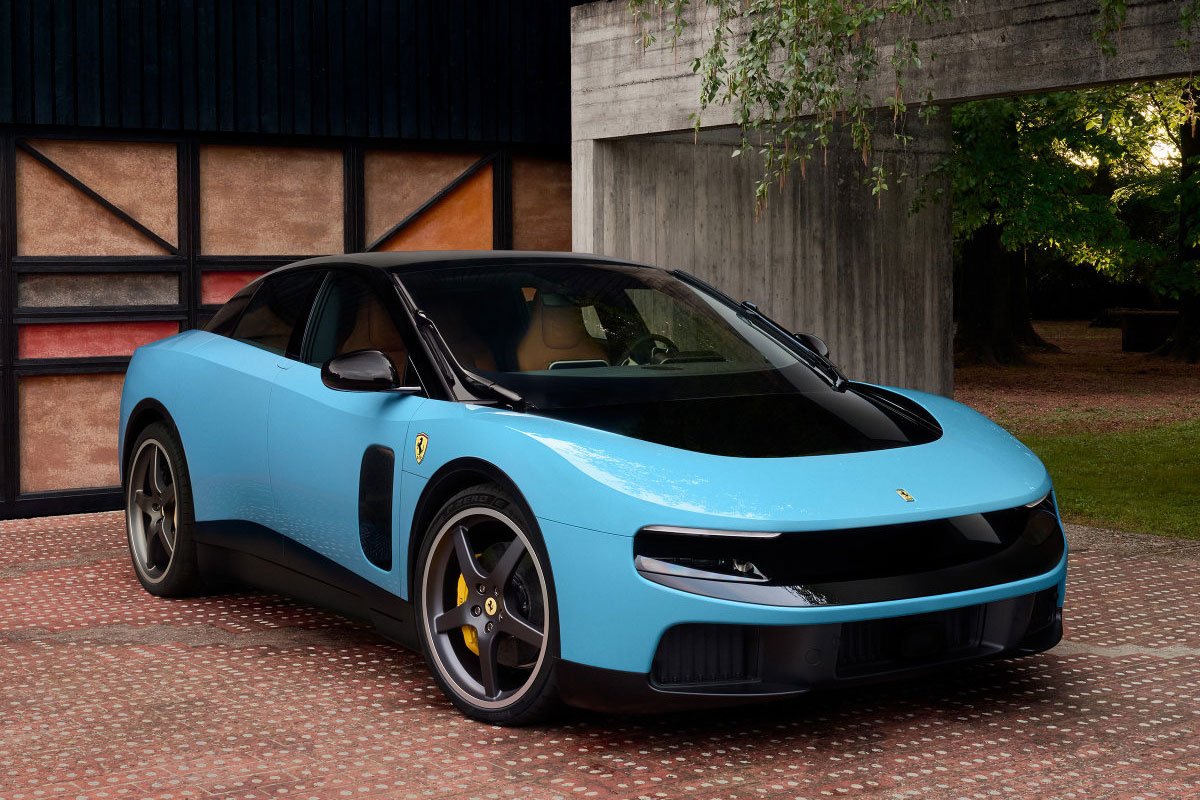
On May 25, 2026, exactly 79 years after Ferrari claimed its first-ever race victory at Rome’s Gran Premio di Roma, the Italian marque returned to the Eternal City to make history of a different kind. Under the vaulted roof of the Vela di Calatrava, Ferrari unveiled the Luce: its first fully electric production car. Five examples of the car, painted in a spectrum from Ferrari red to white and light blue, rolled out under a dramatic light show to signal that the brand synonymous with roaring V12s and fire-breathing mid-engine racers had decisively crossed into a new era.
The Luce, Italian for light, is not just a product launch. It is a philosophical statement, a cultural moment, and, for many watching, proof that electrification and the soul of Ferrari are not mutually exclusive.
Design: Jony Ive, Marc Newson, and a Break from Tradition
For the first time in its history, Ferrari partnered with an external creative studio to shape the character of a production car. That studio was LoveFrom, the collective founded by Sir Jony Ive, the legendary former Chief Design Officer at Apple who shaped the iMac, iPod, and iPhone, and Australian industrial designer Marc Newson.
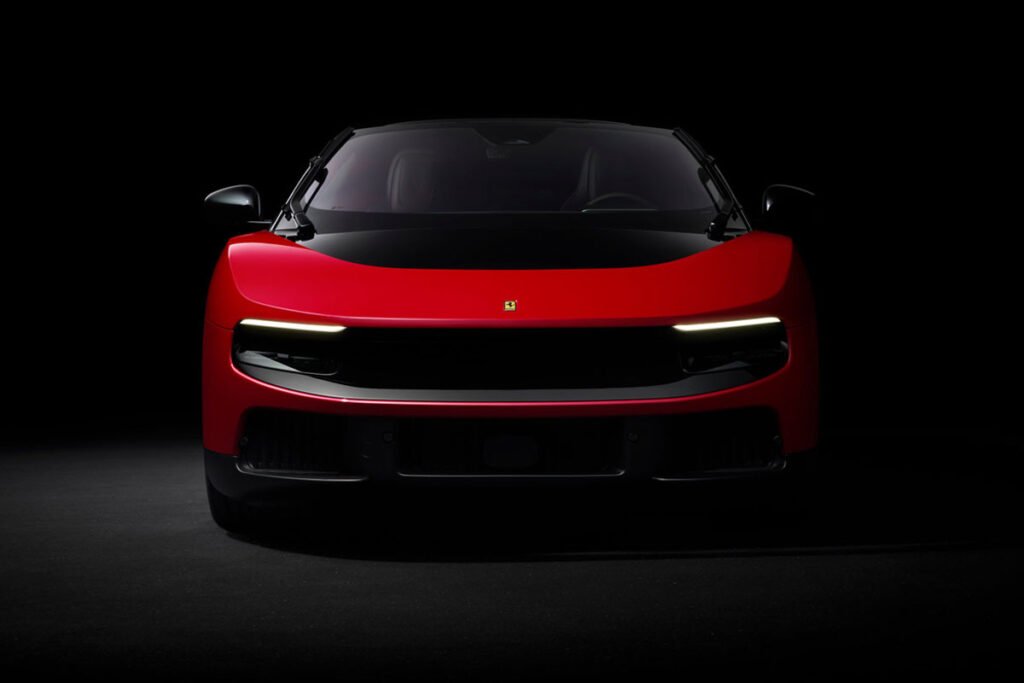
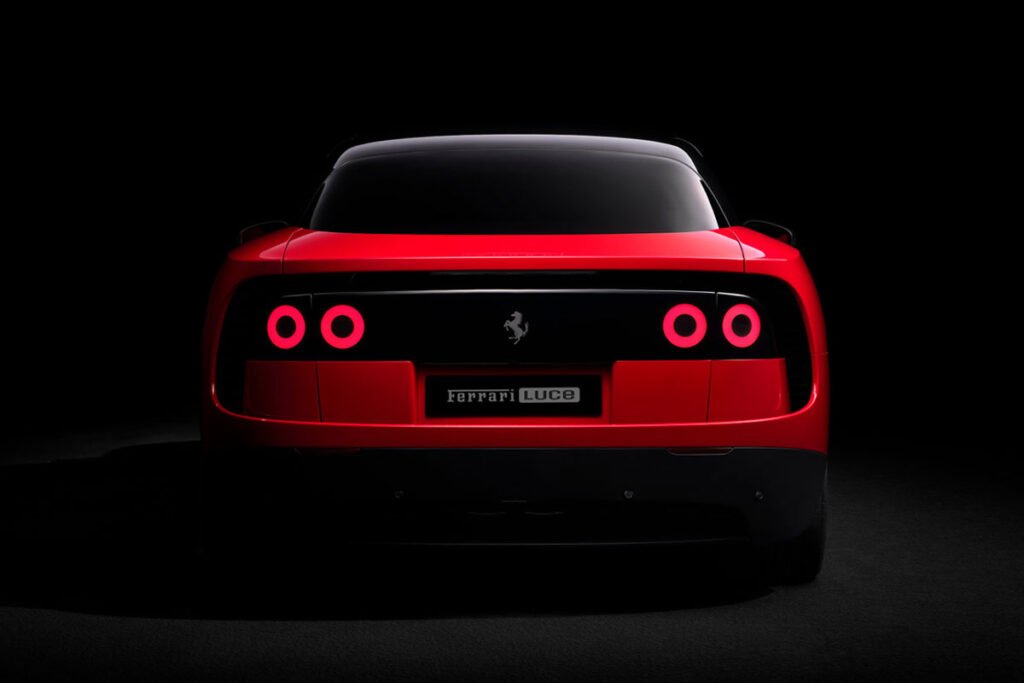
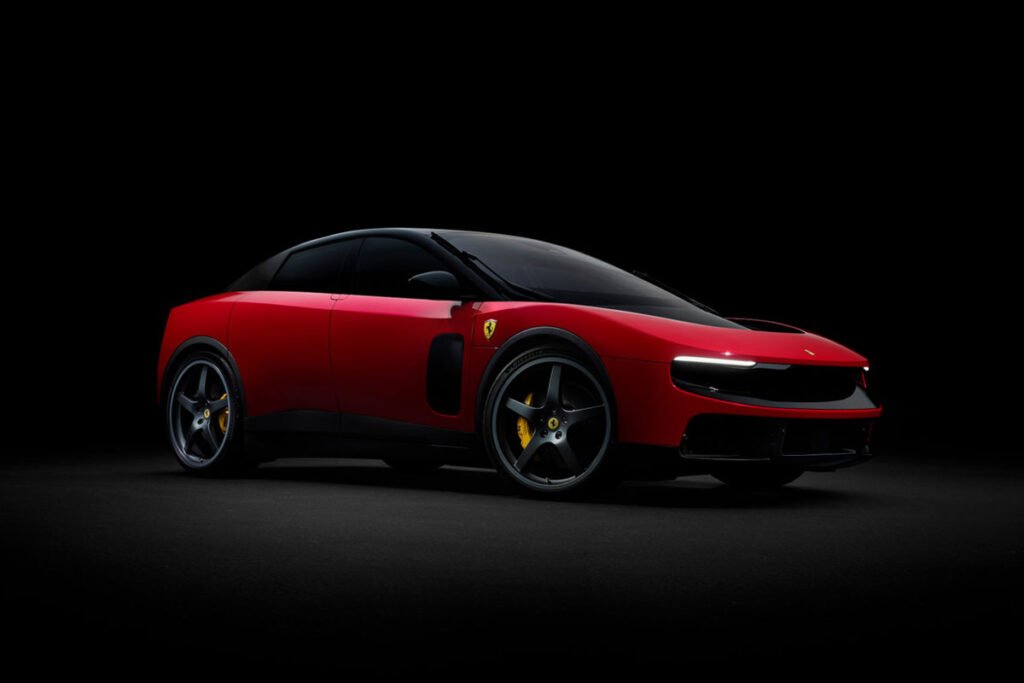
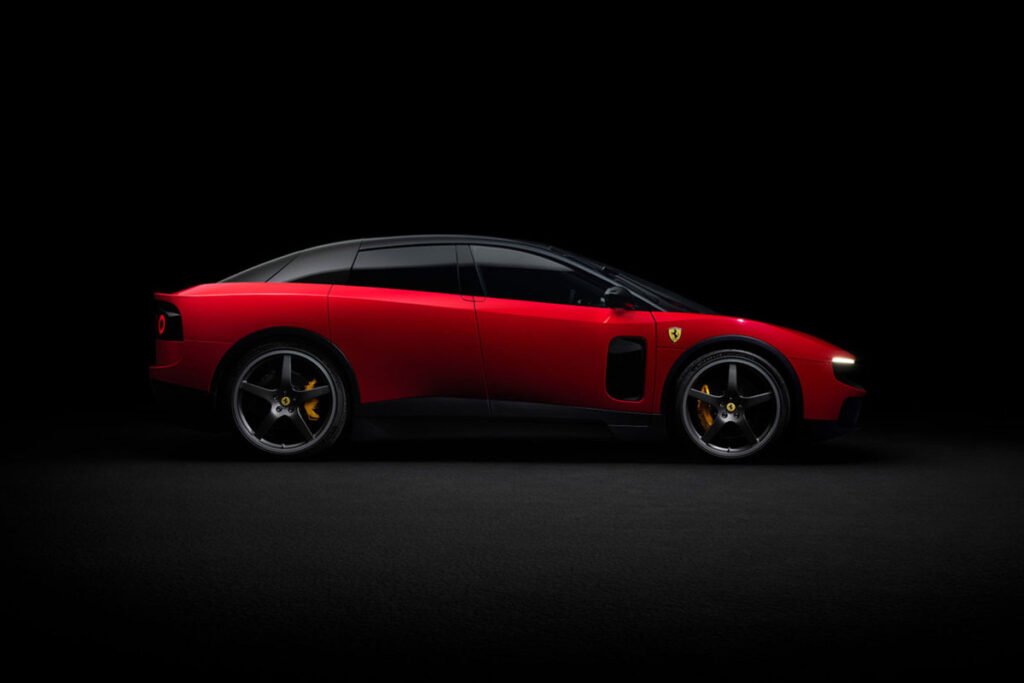
The result is unmistakably unlike any Ferrari that has come before it. Gone is the low-slung, aggressive, muscle-forward silhouette that has defined Maranello’s road cars for decades. In its place stands a large, five-door sedan that some observers have described as a cross between a shooting brake, a wagon, and a saloon, generous in its proportions, architectural in its intent.
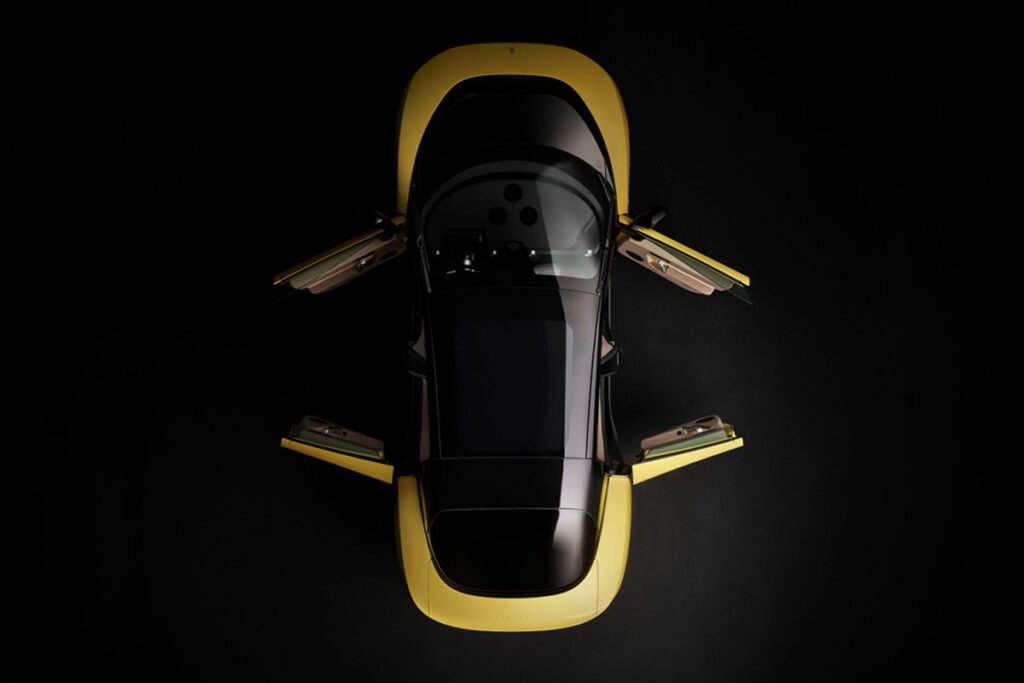
The defining design gesture is what LoveFrom calls the “glasshouse”, a vast, curvaceous greenhouse of glass that encloses the cabin, incorporating a panoramic glass roof, wraparound windscreen, and sweeping side and rear windows. Below this greenhouse sits a body of sculpted aluminium panels that transition into wide, sweeping aerodynamic wings at both the front and rear, creating the visual impression of a single teardrop form draped in a coloured metal shell.
“We intellectually separate the passenger cell, the glasshouse as you’d call it,” Newson explained at the Rome reveal. “It’s surrounded by this aluminium shell, which is effectively the bodywork.”
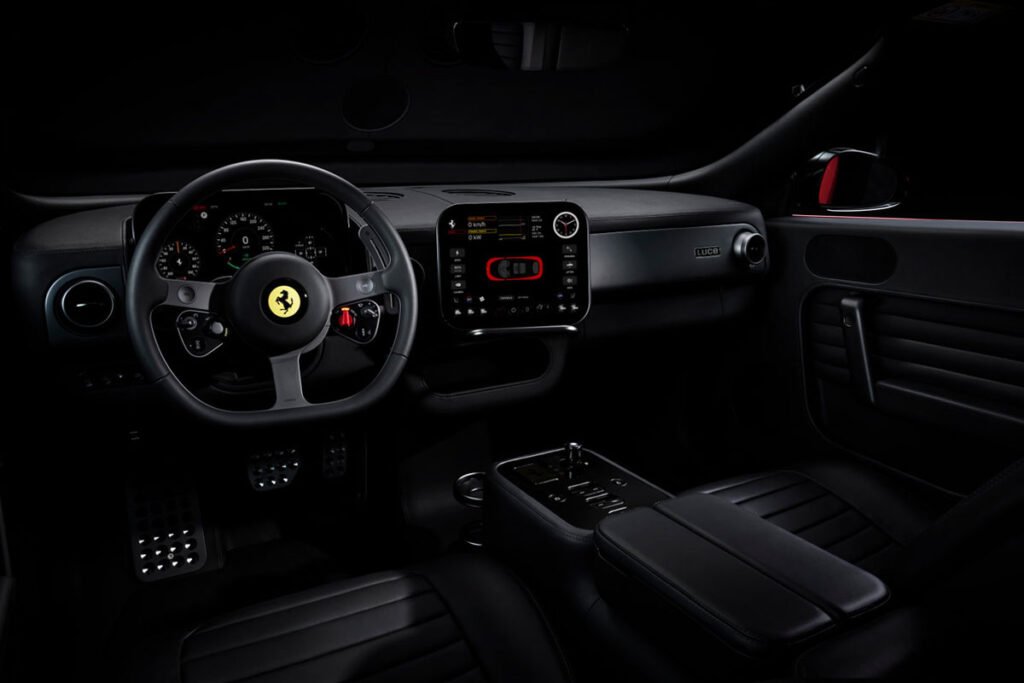
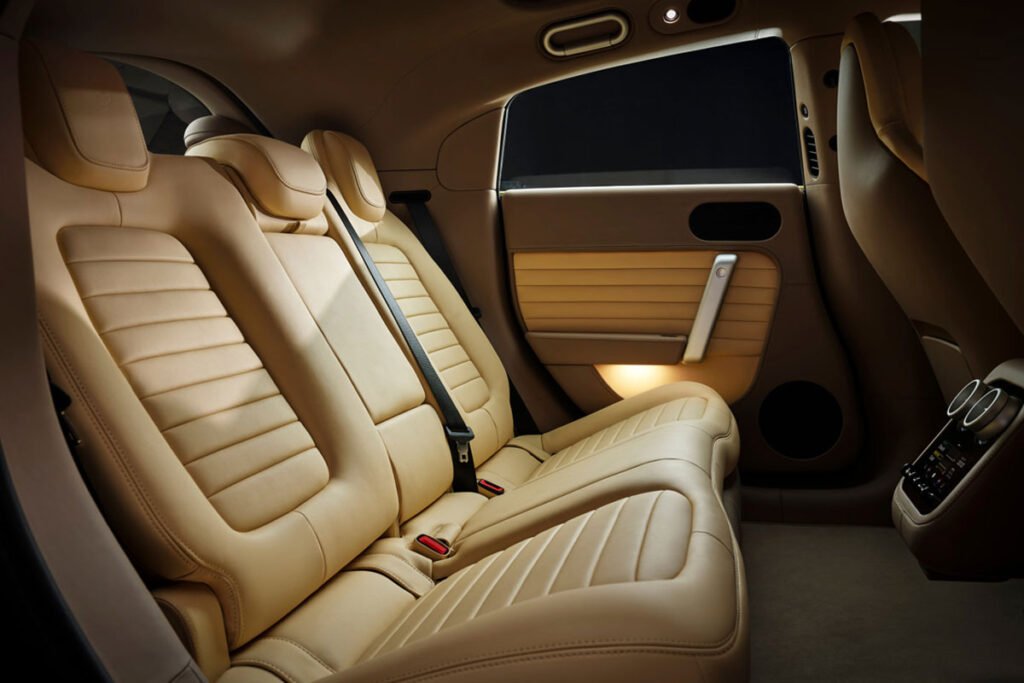
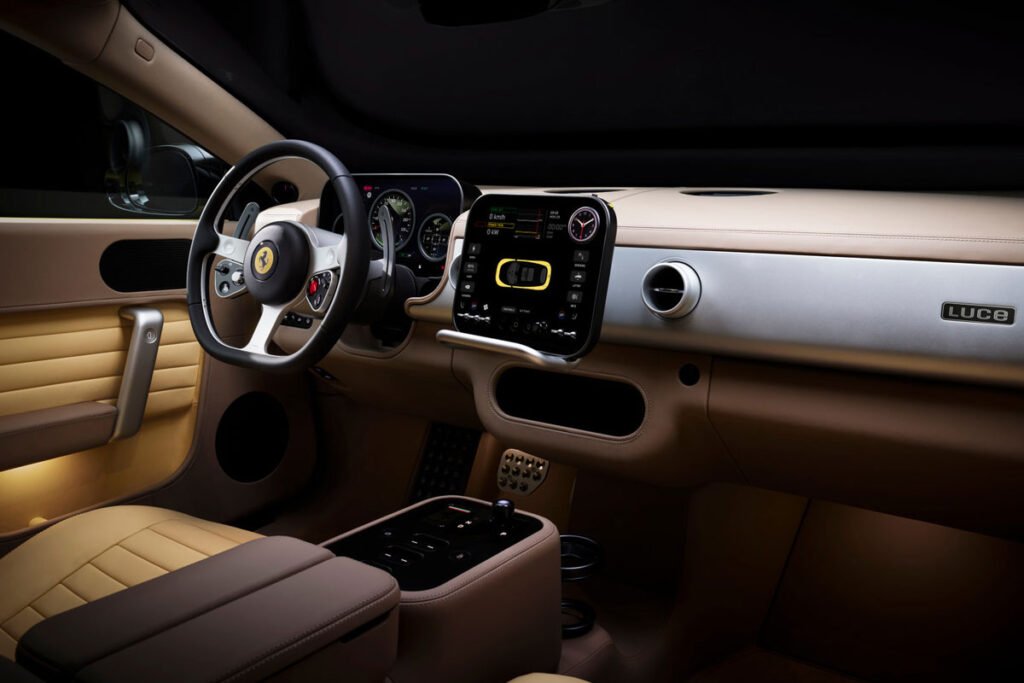
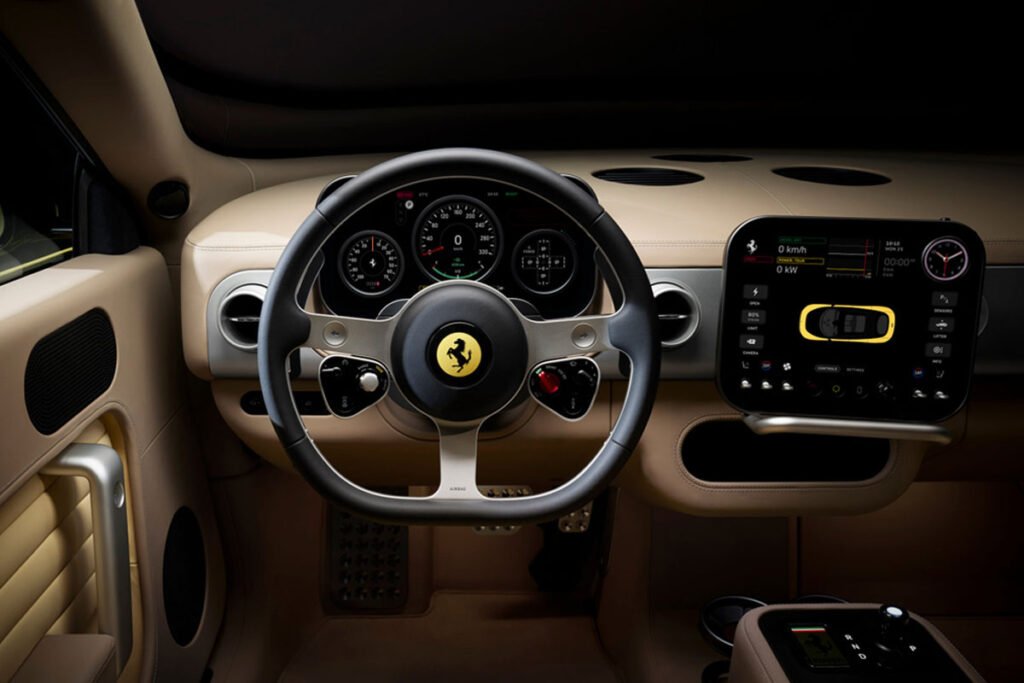
The interior, a collaboration between LoveFrom and Ferrari’s own Centro Stile under Flavio Manzoni, reflects the same philosophy of aerospace-inspired clarity and warmth. The Luce is Ferrari’s first five-seater, and the cabin makes the most of that space, offering what Ferrari describes as a comfortable, technology-rich environment for long-distance travel without sacrificing the driver-focused intensity one expects from Maranello.
Technical Specifications: Engineering Ferrari’s Most Complex Car
Platform
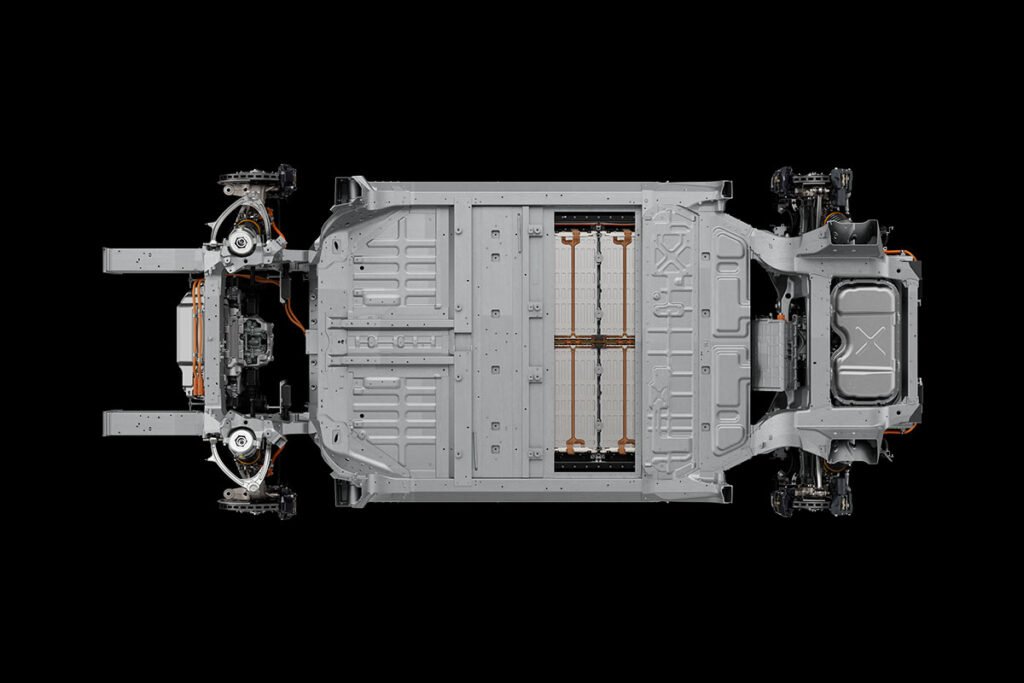
The Ferrari Luce rides on a bespoke, in-house developed 880-volt architecture designated the F222, built from the ground up exclusively for this model. Ferrari created an entirely new dedicated production facility at its Maranello complex, called the E-Building, to manufacture the Luce and its strategic electric components. All high-voltage battery packs, e-axles, and inverters are engineered and produced in-house, giving Ferrari full control over its electric DNA going forward.
Powertrain
The heart of the Luce is a quad-motor, all-wheel-drive system with one radial-flow permanent-synchronous motor at each wheel. Each motor incorporates Formula 1-derived Halbach array magnet technology, optimising the magnetic flux to maximise torque density while minimising weight.
Combined output stands at 1,035 horsepower (830 kW), enabling the Luce to sprint from 0 to 100 km/h in just 2.5 seconds, reach 200 km/h in 6.8 seconds, and top out at over 310 km/h. Individual torque vectoring through each motor provides an extraordinary degree of agility that Ferrari says compensates handsomely for the car’s considerable 2,260-kilogram kerb weight.
Battery and Range
The Luce is equipped with a 122 kWh NMC (Nickel Manganese Cobalt) battery pack supplied by SK On. The WLTP-certified range exceeds 530 kilometres (330 miles) on a single charge. The 880-volt architecture supports ultra-fast DC charging at up to 350 kW, meaning a 10–80% charge can be achieved in under 25 minutes under optimal conditions.
Suspension and Dynamics
Rather than relying on conventional anti-roll bars, the Luce uses a sophisticated 48-volt active suspension system that can independently control each corner of the car, effectively masking the considerable mass while preserving the sharp, communicative handling Ferrari’s clients expect. This is paired with rear-wheel steering for increased agility at low speeds and stability at high speeds, a critical tool for a car of this size and power.
Weight distribution is a carefully engineered 47:53 front-to-rear, helping maintain the rear-biased balance Ferrari engineers prize for driver engagement. The wheelbase measures 2,959 mm (116.5 inches), which is slightly shorter than that of Ferrari’s Purosangue SUV, keeping the car more nimble than its dimensions might suggest.
The Sound of a Ferrari Without an Engine
Among the Luce’s most talked-about technical innovations is its approach to acoustic identity. Ferrari flatly rejected the idea of piping fake engine noise into the cabin, a solution adopted by some EV manufacturers. Instead, Ferrari developed a system that captures, amplifies, and sculpts the actual vibrations and sounds generated by the electric powertrain, creating what the company calls a distinctly electric Ferrari sound.
This is delivered through a 21-speaker audio system engineered specifically for the Luce, featuring ribbon tweeters, sealed-box midrange units, woofers, a subwoofer in an ultra-rigid enclosure, and an ultra-flat speaker headliner that generates a 3D surround experience. The system is powered by 24 amplifier channels and 3,000 watts, managed by Ferrari’s new proprietary Audio Director software platform. The result is said to be visceral and emotionally engaging in a way no artificial engine simulation could achieve.
Specifications Summary
| Specification | Detail |
|---|---|
| Model Code | F222 |
| Body Style | 5-door sedan (5 seats) |
| Platform | Ferrari 880V (bespoke) |
| Powertrain | Quad-motor, all-wheel drive |
| Motor Type | Radial-flow permanent-synchronous (Halbach array) |
| Power Output | 1,035 hp (830 kW) |
| 0–100 km/h | 2.5 seconds |
| 0–200 km/h | 6.8 seconds |
| Top Speed | 310+ km/h |
| Battery | 122 kWh NMC (SK On) |
| Range (WLTP) | 530+ km (330+ miles) |
| Charging | 350 kW DC |
| 10–80% Charge Time | Under 25 minutes |
| Kerb Weight | 2,260 kg |
| Weight Distribution | 47:53 (F/R) |
| Wheelbase | 2,959 mm (116.5 in) |
| Boot Capacity | 600 litres |
| Price | €550,000 ($640,000) |
| First Deliveries | October 2026 (Italy) |
Why Ferrari Was Reluctant: The Long Road to the Luce
Ferrari’s arrival at this moment was anything but swift or enthusiastic. For years, the company resisted the EV revolution with a quiet but firm conviction that internal combustion engines were the irreplaceable soul of the brand, that the roar, the heat, the mechanical drama of a Ferrari V12 were not merely features to be swapped out but fundamental to what Ferrari is.
Former CEO Sergio Marchionne, who led Ferrari until his death in 2018, famously declared that Ferrari would never build an SUV, before the Purosangue arrived, and expressed deep scepticism about pure electrification. The prevailing view at Maranello for years was that an electric Ferrari would be a contradiction in terms.
The reluctance had solid foundations. Ferrari’s entire brand equity is built on sensory experience: the sound of a high-revving V8 climbing to 9,000 RPM, the smell of hot exhaust, the physical sensation of power being unleashed through a mechanically engaging chassis. Early EVs offered none of this, they were quiet, heavy, and, in the eyes of Ferrari purists, emotionally sterile.
Two specific engineering challenges haunted Ferrari’s leadership. The first was weight. A large battery pack capable of providing both sports-car range and performance inevitably adds mass, and mass is the enemy of the light, agile character that defines a great Ferrari. The second was engagement, the absence of the rev-building drama, gear changes, and acoustic theatre that make driving a Ferrari an event rather than merely transportation.
When CEO Benedetto Vigna, a physicist and former executive from semiconductor company STMicroelectronics, took the helm in September 2021, he arrived tasked with navigating electrification while protecting the brand’s soul. His initial plan was ambitious: announcing at Ferrari’s 2022 Capital Markets Day that 40% of the lineup would be fully electric by 2030.
But the global EV market did not cooperate. Demand for high-performance electric cars softened significantly in 2024 and 2025. Lamborghini scrapped its Lanzador EV project entirely, with its CEO stating that market readiness for full EV supercars was “close to zero.” Porsche scaled back its own electric ambitions. Ferrari quietly delayed a planned second EV model until at least 2028.
Yet Ferrari had invested too deeply to reverse course entirely. The E-Building was built. The platform was engineered. Five years of development work had been committed. And crucially, Vigna had begun hearing from a new generation of wealthy customers who wanted an electric Ferrari, clients who would not join the Ferrari family until the brand offered one. As Vigna put it: “Some people say they won’t buy an EV; others say they only want to buy an EV. There are all kinds of people, and it is not a battle between them.”
The Luce was Ferrari’s answer: proof that electrification, done with sufficient engineering ambition and creative vision, could produce a car that was genuinely, undeniably a Ferrari, not in spite of its electric powertrain, but because of how Ferrari chose to deploy it.
Why They Finally Did It: Emotion, New Clients, and the Next Generation
Vigna framed the Luce not as a regulatory concession but as an “emotion-driven” innovation. His argument was that there are three ways a company can innovate: push technology to market and hope customers follow; wait for demand before acting; or start from human emotion and engineer toward it. Ferrari, he argued, chose the third path.
“The EV is an addition, not a transition,” Vigna said at the Rome launch. “Today we are adding to our portfolio of cars, combustion and hybrid, the electric cars. We are not transitioning only to electric cars.”
Several factors ultimately made the Luce not just possible but necessary:
Attracting the next generation. Ferrari’s core clientele is ageing, and the brand recognised that ultra-wealthy younger buyers, technology-native, sustainability-conscious, and often already owners of a Tesla or Lucid, represented a new market segment that would not be won with ICE cars alone.
Competitive pressure. With Porsche, Rimac, and Chinese brands like BYD launching high-performance EVs at eye-watering price points, Ferrari risked ceding the ultra-luxury electric performance space to competitors who would be very difficult to displace later.
The engineering case. Vigna, a microelectronics engineer by training, recognised that EV technology, specifically individual torque vectoring through four independent motors, could actually enhance Ferrari’s core performance metrics in ways a single combustion engine could not. The ability to deliver precisely calibrated torque to each wheel independently is, in engineering terms, a superpower for a performance car.
The LoveFrom collaboration. The decision to bring in Jony Ive and Marc Newson was not merely a marketing exercise. It was a signal that the Luce should be a genuinely new kind of Ferrari, one that a technology-forward, design-literate global audience could embrace without feeling they were compromising. The glasshouse design, the five-seat layout, the 600-litre boot: these are not accidental features. They speak directly to a buyer who wants a Ferrari for every day, not just the weekend.
The Road Ahead: Ferrari’s Future Lineup
The Luce’s arrival does not mark the beginning of a full Ferrari electric revolution, at least not yet. Ferrari’s revised 2030 strategic plan, announced at its October 2025 Capital Markets Day, tells a more nuanced story.
In 2022, Ferrari had boldly targeted a 2030 lineup of 40% electric, 40% hybrid, and 20% ICE. By October 2025, that plan had been materially revised. The new target is 40% ICE, 40% hybrid, and only 20% fully electric, a dramatic inversion of the original EV ambition, driven by the realities of softening global EV demand in the luxury segment.
Under this framework, Ferrari commits to:
ICE, 40% of lineup by 2030. The V6, V8, and V12 combustion engines are not going anywhere. Ferrari has explicitly pledged to continue innovating all three engine families, increasing specific power output and ensuring compatibility with alternative carbon-neutral fuels (e-fuels), which Ferrari views as a potential long-term pathway to keep combustion engines relevant beyond EU emissions deadlines.
Hybrid, 40% of lineup by 2030. Hybridisation remains Ferrari’s most commercially successful electrification strategy. The SF90 Stradale and 296 GTB have proven that electrified powertrains can enhance rather than dilute the Ferrari experience. Expect continued development of plug-in hybrid architectures across the range, including potential hybrid variants of models like the Purosangue.
Fully Electric, 20% of lineup by 2030. The Luce is the first, but almost certainly not the last, fully electric Ferrari. A second EV model is reportedly in development but is not expected to arrive before 2028, with Ferrari proceeding cautiously given the volatile demand environment. Ferrari plans an average of four new model launches per year between 2026 and 2030.
Ferrari’s broader strategy can be summarised in the company’s own motto for this era: “Different Ferrari for different Ferraristi, and different Ferrari for different moments.” It is a philosophy of freedom of choice, placing the customer, not regulation, at the centre of the product roadmap.
Vigna has also been explicit that Ferrari will never pursue autonomous driving. The self-driving capability that competitors are racing toward is, in Ferrari’s view, antithetical to why people buy a Ferrari in the first place. “The last one [autonomy], we don’t care,” Vigna said bluntly at a Financial Times summit.
Conclusion: The Luce and What It Means
The Ferrari Luce is a €550,000, 1,035-horsepower, Jony Ive-designed gamble, and a remarkably calculated one. It addresses a new generation of customers. And it proves a technical thesis. It expands the Ferrari universe without dismantling it. And it does so in the most Ferrari-like way possible: with an insistence that performance, beauty, and emotion are non-negotiable, even, especially, in an electric car.
Whether the Luce converts hardcore petrolheads remains to be seen. But for the automotive world, its significance goes beyond sales numbers. When a brand with Ferrari’s cultural authority says that to make a great car, it had to be electric, the conversation about what EVs can be shifts irrevocably.
The Prancing Horse is not abandoning its past. It illuminates the path forward.
Do let me know in the comments what do you think about Ferrari first EV Luce