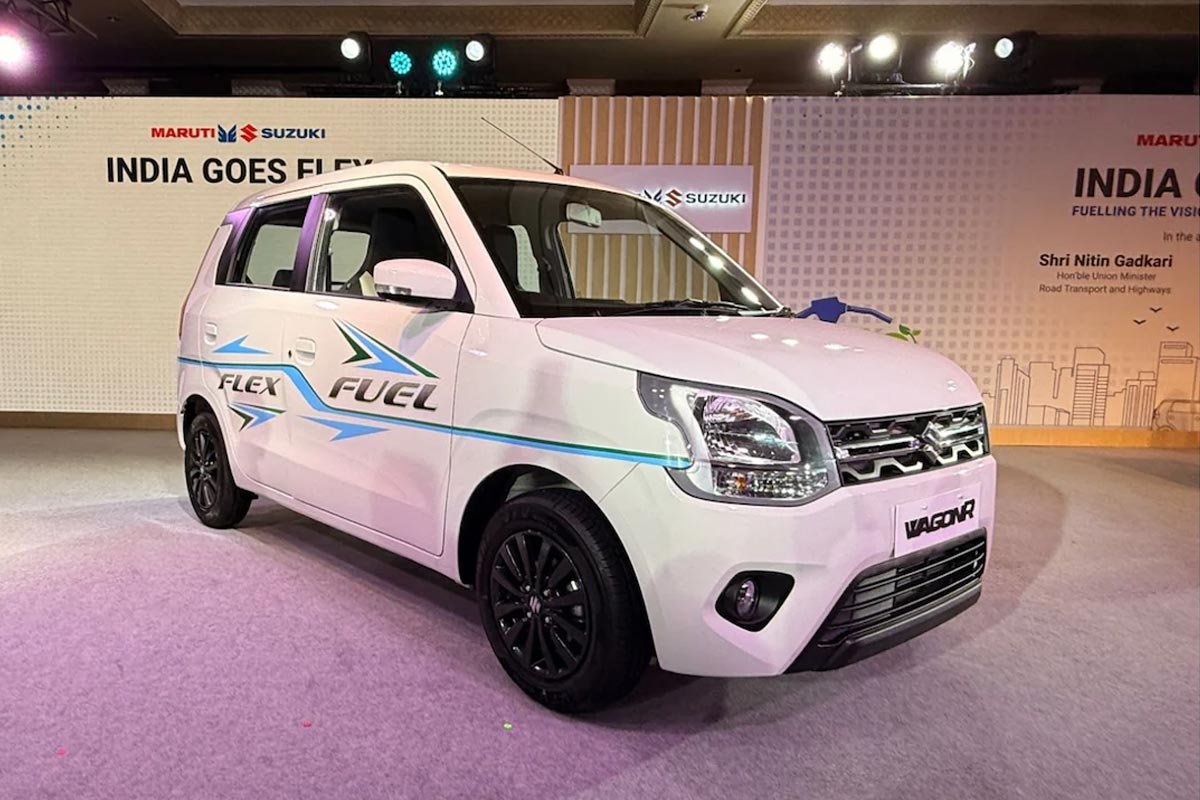
India’s automotive landscape is on the cusp of a historic transformation. On June 5, 2026, World Environment Day, Maruti Suzuki is set to unveil India’s first mass-market E100 Flex Fuel Car (FFV), most likely the iconic WagonR. This is not merely another car launch. It is a statement: India is ready to drive into a cleaner, greener future powered not by imported crude oil, but by homegrown ethanol fermented from sugarcane and grain fields.
This article breaks down everything you need to know, the car itself, what flex fuel means, why it matters for India’s economy and environment, how India produces ethanol, and whether this technology can truly shape our automotive future.
The Launch: Maruti Suzuki’s Historic Moment
Union Minister for Road Transport and Highways, Nitin Gadkari, confirmed the announcement during an event in Nagpur, Maharashtra, on May 23, 2026. The car will be unveiled at a special programme in Delhi on the occasion of World Environment Day, a date deliberately chosen to underline India’s commitment to green mobility.
The model expected to take centre stage is the Maruti Suzuki WagonR, one of India’s highest-selling hatchbacks. A flex-fuel prototype of the WagonR was already showcased at the Bharat Mobility Global Expo 2025, having been developed locally with support from Suzuki Motor Corporation, Japan. The WagonR’s mass-market positioning, affordable, practical, and with a wide urban and semi-urban customer base, makes it the ideal candidate to introduce this technology to everyday Indian buyers.
Maruti Suzuki also displayed a Fronx flex-fuel concept at the same expo, leaving open the possibility of a premium variant down the line.
Key Specs at a Glance
| Feature | Details |
|---|---|
| Model | Maruti Suzuki WagonR (expected) |
| Fuel Compatibility | E20 to E100 (pure ethanol) |
| Engine | 1.0L tuned petrol-based unit, optimised for high-ethanol blends |
| Transmission | Manual / AMT |
| Expected Price | ~₹8.00 lakh (ex-showroom) |
| Premium over standard | ₹50,000–₹75,000 approximately |
| Design Changes | Flex-fuel badging, revised decals; overall form unchanged |
| Regulatory Clearance | MoRTH included E100 in certification norms in April 2026 |
Note: Official mileage figures are yet to be confirmed. Ethanol has a lower energy density than petrol, so per-litre mileage on E100 will be lower, but since ethanol is significantly cheaper than petrol, the per-kilometre running cost is expected to remain competitive.
What is a Flex Fuel Car?
A Flex Fuel Car (FFV) is a car whose engine is engineered to run on a wide range of fuel blends, from standard petrol (E0) all the way to pure ethanol (E100), or any combination in between. The “flex” in flex fuel refers to this flexibility.
Traditional petrol engines are tuned for a specific air-fuel ratio and fuel composition. High-ethanol fuels behave differently, they have a higher octane rating, different energy content, and require modified fuel system components to prevent corrosion. A flex-fuel engine incorporates:
- Corrosion-resistant fuel lines and injectors: ethanol is more corrosive than petrol.
- Modified fuel injection systems: ethanol requires more fuel volume to produce the same energy.
- Adjusted compression ratios: to take advantage of ethanol’s higher octane number.
- Cold-start optimisation: pure ethanol is harder to ignite in cold weather and needs special management.
- Electronic sensors: the engine’s ECU (Electronic Control Unit) detects the ethanol blend percentage and automatically adjusts combustion parameters.
From the driver’s perspective, a flex-fuel car looks and operates exactly like any other car. You simply fill up, whether the pump dispenses E20, E85, or E100, and the car adjusts itself.
Brazil, the world’s foremost flex-fuel market, has been running FFVs since the early 2000s. Over 75% of new cars sold in Brazil today are flex-fuel vehicles. India is now attempting to build a similar ecosystem.
Benefits of a Flex Fuel Car
1. Dramatic Reduction in Import Dependency
India imports approximately 87% of its crude oil, spending close to ₹22 lakh crore annually on fossil fuel imports. Every litre of ethanol that replaces petrol directly reduces this outflow. India has already saved over ₹1.36 lakh crore in foreign exchange through its ethanol blending programme alone. Scaling up to E100-capable vehicles accelerates these savings exponentially.
2. Lower Fuel Costs for Consumers
Ethanol is considerably cheaper than petrol at the pump. While mileage on pure ethanol is lower (ethanol has roughly 67% of the energy content of petrol per litre), the cost-per-kilometre can still be lower, depending on ethanol pricing. The government has the ability to keep ethanol prices stable as it is domestically produced, insulating consumers from global crude oil price volatility.
3. Cleaner Emissions
Ethanol is a biofuel. When burned, it releases carbon dioxide, but the sugarcane or maize that produced that ethanol absorbed CO₂ from the atmosphere during its growth. This creates a near-carbon-neutral cycle. In practice, ethanol-blended fuels reduce particulate matter, carbon monoxide, and unburned hydrocarbon emissions significantly compared to pure petrol. Urban air quality, a severe problem in cities like Delhi, Mumbai, and Pune, can meaningfully improve with the mass adoption of flex-fuel vehicles.
4. A Practical Bridge Technology
India’s EV transition is underway, but faces well-known obstacles: high battery costs, limited charging infrastructure in Tier 2 and Tier 3 cities, and range anxiety. Flex fuel provides an immediate, practical green alternative using existing petrol engine architecture and existing fuel distribution networks. It is affordable, familiar, and scalable right now.
5. Empowering Farmers
Ethanol in India is largely produced from sugarcane and damaged food grains. Increased ethanol demand means stable, higher prices for farmers growing these crops. It transforms agricultural surplus, previously a burden on the government, into an energy asset. This is a direct transfer of economic value from oil-importing corporations to India’s rural farming communities.
6. Energy Security and Strategic Independence
A nation that fuels its vehicles with domestically grown crops is strategically more secure than one dependent on geopolitically volatile oil-producing regions. Flex fuel is, at its core, an energy sovereignty play.
Challenges of Flex Fuel Adoption in India
Despite the promise, the road to widespread flex fuel adoption is not without significant potholes.
1. Limited Fuel Availability
The most immediate obstacle: E100 ethanol is simply not available at most petrol pumps across India. While the government has achieved 20% blending in petrol across the country, pure ethanol dispensing infrastructure is virtually non-existent for retail consumers. Building this nationwide would require massive investment in storage, distribution, and retail infrastructure.
2. Higher Vehicle Cost
Industry insiders estimate that ethanol-compatible modifications, corrosion-resistant materials, modified fuel systems, revised ECU, add approximately ₹50,000 to ₹70,000 to the manufacturing cost of a vehicle. At a segment where buyers are highly price-sensitive, this premium is a real barrier.
3. Lower Energy Density = More Refuelling
Ethanol contains roughly one-third less energy per litre than petrol. A car running on E100 will need to refuel more often for the same distance. While lower fuel prices can compensate economically, the practicality of more frequent stops, especially in regions where ethanol pumps are sparse, remains a concern.
4. Cold-Start Difficulties
Ethanol does not vaporise easily in cold conditions, making cold starts difficult in colder regions. Engineering solutions exist (heated fuel systems, small petrol reserves for starting), but they add to complexity and cost.
5. Food vs. Fuel Dilemma
India’s ethanol is primarily produced from sugarcane, a water-intensive crop. Diverting large quantities of sugarcane towards ethanol rather than sugar has already placed upward pressure on sugar prices, affecting household budgets. The delicate balance between ensuring food security and fuel security must be carefully managed through smart policy.
6. Water Stress
Producing one litre of ethanol from sugarcane requires approximately 2,860 litres of water. Scaling ethanol production massively without diversifying feedstocks could severely worsen groundwater depletion in states like Maharashtra, Uttar Pradesh, and Karnataka, regions already vulnerable to drought and water shortages.
How India Produces Flex Fuel (Ethanol)
India’s ethanol production story is a genuine success. Production has surged from just 38 crore litres in 2014 to over 661 crore litres by mid-2025, a 17-fold increase in just over a decade.
Primary Feedstocks
1. Sugarcane and its by-products The dominant source. Sugarcane juice, sugar syrup, B-heavy molasses, and C-heavy molasses are all used. Sugarcane-based ethanol producers account for approximately 4,710 million litres of India’s capacity. Since November 2024, the government has permitted the use of sugarcane juice and syrup directly for ethanol manufacturing, removing earlier restrictions.
2. Grain-based sources Rice and maize are increasingly significant. Grain-based units contribute approximately 13,040 million litres of installed capacity. Broken rice, damaged wheat, and rotten potatoes, materials unfit for human consumption, are processed into ethanol, effectively converting food waste into clean fuel.
3. Other agricultural materials The National Biofuel Policy of 2018 (amended in 2022) expanded the permitted feedstock list to include sweet sorghum, sugar beet, cassava, and certain crop residues.
The Production Process
Ethanol is produced through fermentation, where microorganisms (typically yeast) break down the sugars in the feedstock into ethanol and carbon dioxide. The resulting liquid is then distilled to achieve fuel-grade purity. Modern plants produce valuable by-products, including bagasse (used for energy generation), press-mud (used as fertiliser), and carbon dioxide (used in food and beverage industries).
Scale of Investment
The ethanol sector has attracted over ₹40,000 crore in investments since 2018, resulting in a 140% surge in India’s ethanol production capacity. For the 2025-26 season, the government has lifted all quantitative restrictions on ethanol production from sugarcane feedstocks, a signal of strong policy confidence.
Is Flex Fuel Good for India’s Future?
The honest answer is: yes, but with important caveats.
The Case For
India is uniquely positioned to benefit from flex fuel. It is the world’s second-largest sugarcane producer and has vast arable land and a large farming community. Ethanol is a bridge technology that works within existing engine technology, existing fuel infrastructure, and existing consumer behaviour. It creates rural jobs, reduces the fuel import bill, and cuts urban emissions, all simultaneously.
The government has demonstrated that when the policy framework is right, India can scale fast. The jump from 1.5% to 20% ethanol blending in just 11 years is proof of that. Flex fuel car is the natural next step, consuming ever-higher ethanol blends as supply grows.
The Need for Smart Policy
The future of flex fuel in India depends on solving several parallel challenges:
Diversify feedstocks. India cannot rely solely on sugarcane. Maize, sorghum, bamboo, and agricultural residue-based second-generation (2G) ethanol must be scaled. 2G ethanol, produced from crop stubble, rice straw, and other waste, does not compete with food production and uses far less water.
Build the fuelling infrastructure. Dedicated ethanol pumps need to become standard at petrol stations, at least in major cities and on national highways, before mass adoption is viable.
Ensure price parity. Consumers will adopt ethanol enthusiastically if and only if the energy-adjusted cost of ethanol is competitive with petrol. The government must ensure ethanol pricing remains stable and affordable.
Protect water resources. Incentives for water-efficient farming, drip irrigation, and non-water-intensive ethanol feedstocks are essential to prevent the fuel revolution from causing an ecological crisis.
A 5-to-10 Year Horizon
Maruti Suzuki’s own senior executive has framed the flex-fuel market as a “futuristic plan”, expecting volumes to be minimal initially, becoming meaningful only five to ten years from now. This is a realistic assessment. The June 5 launch is the planting of a seed, not an overnight harvest.
India’s flex fuel market, valued at approximately $611.8 million in 2023, is projected to reach $1,627.4 million by 2030, a compound annual growth rate of 15%. The trajectory is clear. The pace depends on infrastructure, policy, and consumer confidence.
Why This Matters More for India Than for Any Other Country
For most developed nations, flex fuel is one option among many in a broad clean energy portfolio. For India, it is something more fundamental.
India is a country of 1.4 billion people, where two-thirds of the population lives in rural areas, where EV penetration remains low, and where millions of households are deeply affected by petrol price fluctuations. A technology that harnesses domestically grown crops, empowers farmers, reduces the import bill by trillions of rupees, cuts urban pollution, and keeps mobility affordable, without requiring consumers to fundamentally change their behaviour, has enormous, unique relevance here.
When a WagonR running on pure ethanol grown in a Maharashtrian sugarcane field pulls up to a school in a Pune suburb, that journey will represent far more than a kilometre covered. It will represent energy independence, cleaner air, a farmer’s livelihood, and a rupee kept within India, rather than sent to an oil-producing nation halfway around the world.
Maruti Suzuki’s June 5 moment is a beginning. A small, careful, deeply significant beginning. What do you think about Flex fuel car let us know in the comments.